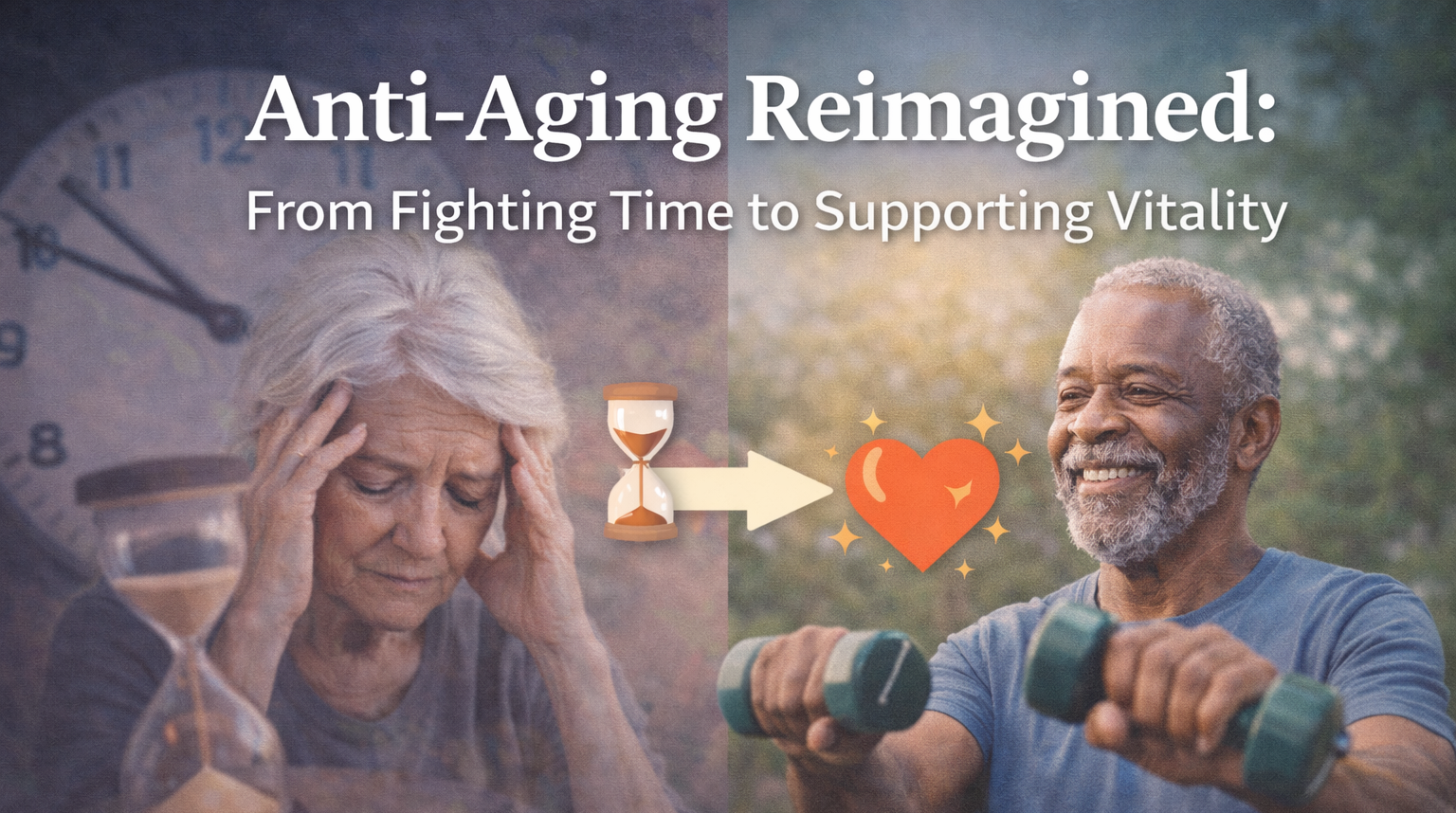
For years, anti-aging has been marketed as a battle.
Creams that promise reversal. Supplements that claim youth in a bottle. Procedures framed as time machines.
But what if anti-aging isn’t about fighting age at all?
What if it’s about extending vitality, protecting function, and supporting the systems that allow us to live well, longer?
The science of aging has evolved. And so has the meaning of anti-aging.
The Shift From “Anti” to “Healthy Longevity”
Leading researchers in aging science increasingly avoid the term “anti-aging” altogether. Instead, they speak about healthspan, the number of years we live in good health, not just lifespan.
Dr. David Sinclair, a geneticist at Harvard Medical School, has written extensively about the biology of aging, emphasizing that aging is driven by cellular processes that may be influenced by lifestyle and emerging therapies.
Dr. Peter Attia, a physician focused on longevity medicine, reframes the goal clearly: extend the years of functional capacity, not just survival.
And Dr. Nir Barzilai, director of the Institute for Aging Research at Albert Einstein College of Medicine, studies populations who live exceptionally long lives, focusing on metabolic health and genetic resilience.
The consensus across these experts is consistent:
Aging is biological, but decline is not entirely inevitable.
What Actually Impacts Biological Aging?
While the market often focuses on surface changes, the real drivers of aging occur deeper within the body.
Research in geroscience points to several key mechanisms:
- Cellular damage and inflammation
- Metabolic dysfunction
- Loss of muscle mass and strength
- Mitochondrial decline
- Reduced stress resilience
- Social isolation and chronic stress
Interestingly, many of the most powerful “anti-aging” interventions are not cosmetic at all.
They are behavioral.
The Foundations of Modern Anti-Aging
Evidence from public health and longevity research consistently highlights several core pillars:
1. Strength and Muscle Preservation
Muscle mass declines naturally with age, a process known as sarcopenia. Loss of muscle is closely linked to frailty, falls, and loss of independence.
Resistance training is one of the most consistently supported longevity interventions. It improves metabolic health, cognitive resilience, and overall mobility.
In many ways, strength is one of the most underrated anti-aging strategies available.
2. Metabolic Health
Insulin sensitivity, blood sugar regulation, and cardiovascular health are strongly tied to aging outcomes.
Research from institutions studying centenarian populations suggests that metabolic stability plays a significant role in long life with preserved function.
Dietary patterns that emphasize whole foods, adequate protein, and anti-inflammatory nutrients tend to outperform restrictive or extreme regimens.
3. Cognitive Engagement and Purpose
Studies in successful aging, influenced by researchers such as Dr. John Rowe and Dr. Robert Kahn, highlight that engagement, purpose, and social activity are as critical as physical health.
Chronic loneliness has been associated with increased mortality risk, as demonstrated in research by Dr. Julianne Holt-Lunstad.
The brain ages differently when it remains socially and cognitively active.
Purpose is protective.
4. Stress Regulation
Chronic stress accelerates biological aging markers. Sleep disruption, social isolation, and lack of routine increase physiological wear and tear.
Daily structure, meaningful connection, and consistent rhythms regulate the nervous system.
Anti-aging, at its core, is nervous system support.
The Role of Technology in Modern Longevity
A new generation of health technologies now supports aging proactively rather than reactively.
Wearables monitor sleep and heart rate variability. AI-driven platforms encourage daily routines. Digital check-ins support consistency and connection.
But experts repeatedly caution against one misconception:
There is no single miracle intervention.
Longevity is cumulative.
Small, consistent behaviors compound over years.
Moving Beyond Cosmetic Anti-Aging
The beauty industry often equates anti-aging with appearance. While skincare and aesthetic medicine have their place, they address only one dimension of aging.
True vitality includes:
- Strength
- Cognitive clarity
- Emotional resilience
- Social connection
- Functional independence
The question is no longer how to look younger.
It is how to feel capable, engaged, and strong at every stage of life.
The Future of Anti-Aging
The future likely lies at the intersection of:
- Preventative health
- Behavioral science
- Personalized medicine
- Digital daily support
- Community infrastructure
Rather than reversing time, the more realistic and empowering goal is extending vitality.
Anti-aging, redefined, is not about denial of age.
It is about honoring the body, protecting function, and designing daily life in a way that sustains identity and purpose.
The real breakthrough is not youth.
It is sustainable strength.