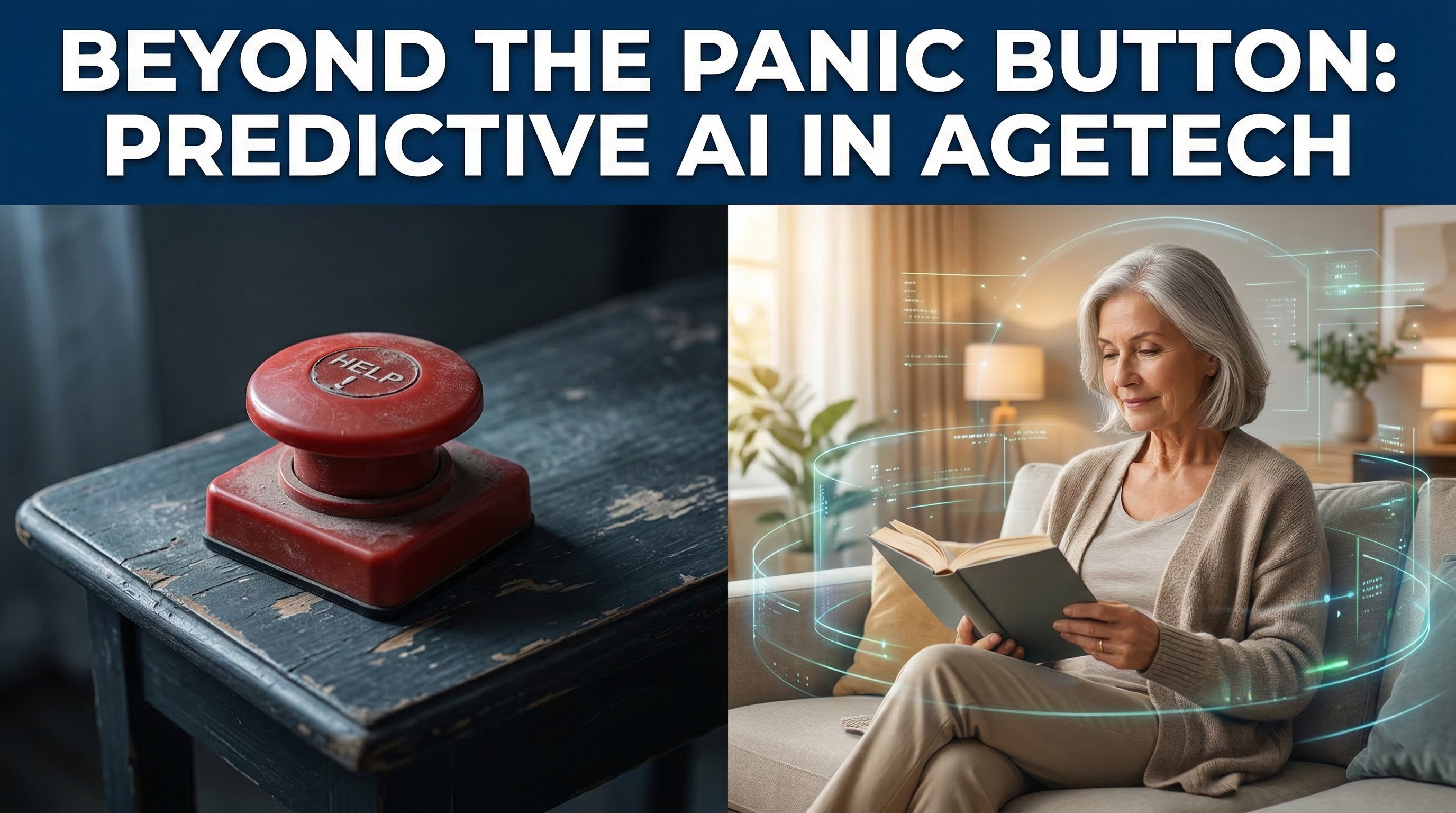
For several decades, the technology for aging in place has been dominated by a reactive logic, best illustrated by traditional medical alert panic buttons. While these systems have undeniable utility, their effectiveness relies on two fragile conditions: the individual must be wearing the device and must be physically and cognitively capable of activating it when an incident occurs. However, studies show that a significant portion of older adults fail to trigger the alarm after a fall due to forgetfulness, confusion, motor incapacity, or loss of consciousness.
Today, AgeTech is evolving towards a much more preventive approach, relying on predictive AI and passive ambient sensors. The goal is no longer just to detect an emergency after the fact, but to identify weak signals in daily routines that forecast a decline in health. This evolution fits into the broader framework of digital biomarkers—health indicators derived from behavioral data collected seamlessly in everyday life.
1) From Emergency Response to Monitoring Activities of Daily Living (ADLs)
Contemporary aging-in-place systems increasingly rely on non-intrusive sensors, such as motion detectors, contact sensors on doors, pressure mats, and water or electricity usage monitors. A review in the Interactive Journal of Medical Research precisely describes these technologies, demonstrating their ability to track Activities of Daily Living (ADLs and IADLs) at home, which is central to the early detection of health changes. Examples include opening sensors for cupboards or refrigerators, as well as presence sensors in different rooms.
The value of these sensors is twofold:
- They reduce cognitive load: Unlike certain wearables, they do not require constant action, charging, or interaction from the user.
- They enable individual routine modeling: AI learns what is "normal" for a specific person and flags relevant deviations. A recent article on passive home monitoring explicitly highlights the ability of algorithms to detect subtle behavioral changes that may indicate a health issue, cognitive decline, or an impending emergency.
2) Digital Biomarkers: When Habits Become Clinical Signals
The concept of digital biomarkers is gaining significant traction in geriatrics. The European project RADAR-AD (often cited in recent literature) perfectly illustrates this approach: sensors and tracking devices are used to link daily behaviors—such as sleep, mobility, and meal preparation—to cognitive and functional trajectories. The challenge is to produce indicators that are more continuous and ecologically valid than periodic clinical assessments.
In other words, AI does not directly "see" a disease; it identifies behavioral deviations (e.g., less time spent cooking, altered waking hours, or slowed mobility). These deviations then become clinical warning signals to be interpreted by family members or healthcare professionals. This distinction is crucial: we are talking about an aid for early detection, not an autonomous medical diagnosis made by a machine.
3) Three Plausible and Documented Clinical Applications
a) Anticipating Fall Risk
Recent literature on fall prevention shows a progressive shift from simple post-fall detection to risk monitoring models based on mobility, balance, and gait. Reviews from 2024–2025 highlight the value of ambient sensors and machine learning, while reminding us that performance varies greatly depending on the devices, study contexts, and data quality.
In practice, this means that changes such as a slowing walking speed, modified transitions (e.g., from sitting to standing), or increased instability can signal a higher risk of falling. This justifies early interventions like medication reviews, physical therapy, or a home safety assessment. However, these systems must not be presented as "infallible"—their true clinical robustness heavily depends on deployment conditions.
b) Early Detection of Infections (e.g., Urinary Tract Infections)
Among older adults, urinary tract infections (UTIs) are frequent and can lead to unplanned hospitalizations, particularly for those living with cognitive impairments. Studies on digital home monitoring show that analyzing routines—such as sleep disruption, nighttime activity, and mobility—can contribute to the early detection of infectious episodes, complementing standard clinical evaluations.
Here, scientific rigor is vital: sensors do not "diagnose" an infection. Instead, they flag behavioral anomalies (e.g., increased nighttime bathroom visits or sudden changes in daily activity levels) that warrant a faster medical check-up. This logic of early flagging is precisely the added value of AI in home care.
c) Early Identification of Mild Cognitive Impairment (MCI) and Apathy
Research on digital biomarkers in cognition rests on the premise that early cognitive disorders often alter the way a person performs habitual activities: meal preparation time, routine regularity, sleep patterns, and overall movement. Work related to RADAR-AD and other home-monitoring studies shows that this data can be leveraged to detect subtle changes, which are potentially useful for identifying Mild Cognitive Impairment (MCI) or a decline in daily engagement.
Again, methodological caution is essential: these tools do not replace neuropsychological evaluations or geriatric consultations, but they can significantly improve the continuity of observation between medical appointments.
4) Ethical and Social Limits: The Condition of Legitimacy
Technological enthusiasm must not overshadow ethical considerations. A systematic review published in BMC Geriatrics clearly identifies several major barriers to the adoption of home health technologies by older adults: cost, social acceptability, ease of use, and privacy concerns.
These concerns are also detailed in a recent article in AJOB Empirical Bioethics, which emphasizes multiple dimensions of privacy—informational, psychological, and sometimes physical—as well as the risk of stigmatization or perceived loss of autonomy if the individual feels "surveilled" rather than supported.
Furthermore, co-design studies with older adults show that the acceptance of these systems heavily depends on concrete conditions:
- Privacy-respecting devices (often camera-free).
- Reasonable and accessible pricing.
- Flexibility according to evolving needs.
- Clear control over data sharing (with family, healthcare professionals, or service providers).
Ultimately, the question is not just "Does it work?" but also: "Under what conditions does this technology remain dignified, acceptable, and fair?"
Conclusion
Aging in place is entering a new phase: moving from a logic of crisis response to one of preventive monitoring and the detection of weak signals. This transition is supported by real advancements in AI, ambient sensors, and digital biomarkers, with promising applications for falls, infections, and cognitive tracking.
However, the value of these technologies will only be sustainable if they remain clinically cautious, ethically regulated, and socially accessible. The true success of AgeTech will not be to "replace" human connection, but to create an environment where silent prevention actually helps preserve it.