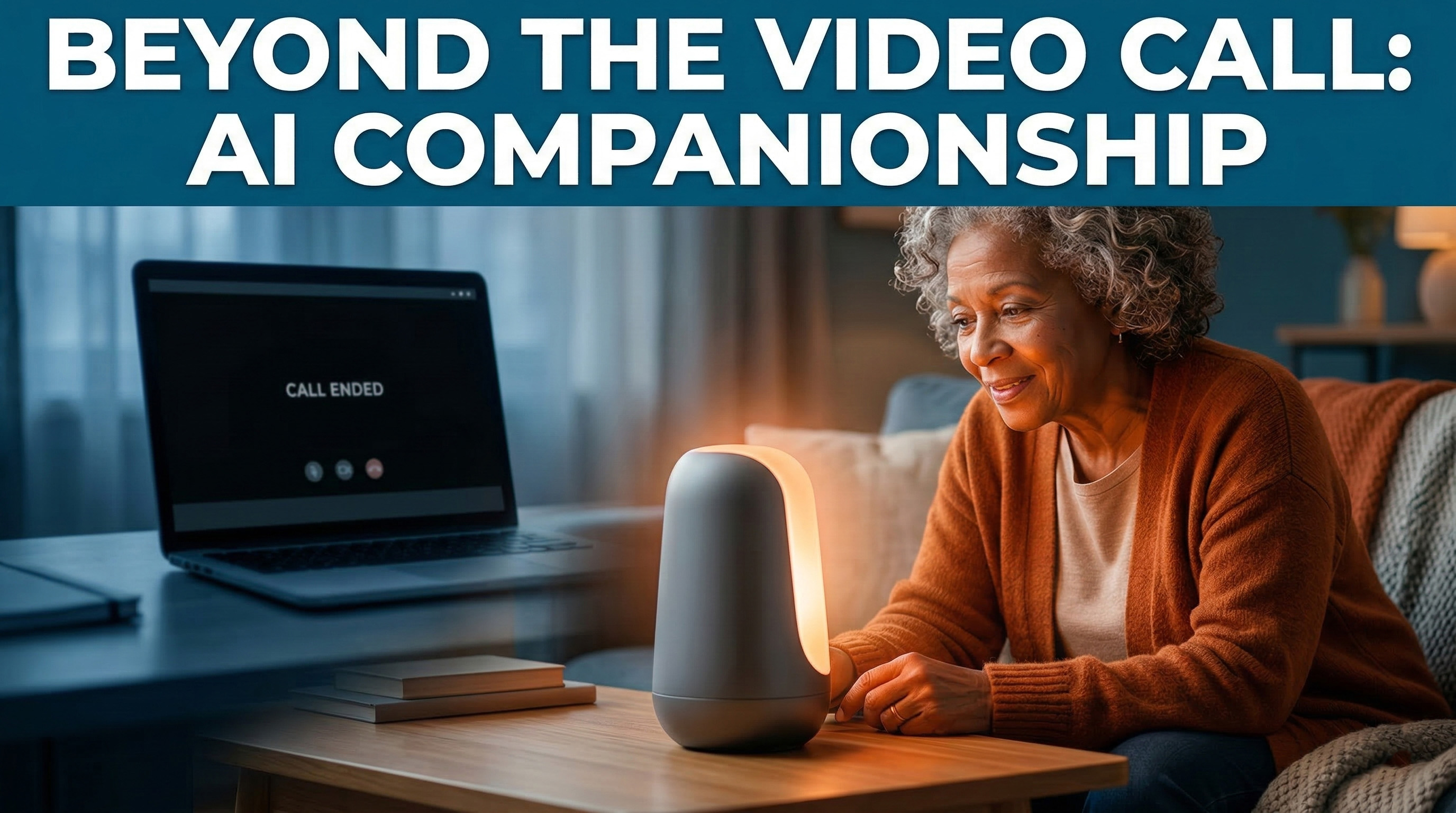
Beyond the Video Call: AI Companionship and the New Frontline Against Senior Loneliness
Introduction — Why "Beyond the Video Call"
The COVID-19 pandemic systematized the use of videoconferencing as a palliative for the isolation of older adults. However, clinical hindsight reveals its structural limitations: the mere availability of a synchronous communication channel does not resolve loneliness. These platforms assume that a human interlocutor is available, motivated, and consistent—a condition rarely met for the most isolated seniors.
Senior loneliness is not a passing discomfort. Meta-analyses establish a significant correlation between chronic loneliness and accelerated cognitive decline, depression, cardiovascular diseases, and premature mortality (Holt-Lunstad et al., 2015). The World Health Organization classified it as a "pressing health threat" by launching a dedicated international commission on social connection in 2023.
Faced with this reality, the AgeTech ecosystem is initiating a transition. Devices are evolving from mere communication tools into "social wellness" environments supported by artificial intelligence: conversational agents, emotional signal analysis, and relational mediation algorithms. Analyzing this transition requires evaluating both the psychosocial value of these technologies and the ethical risks inherent in their deployment.
Defining Loneliness: A Two-Dimensional Approach
Social Isolation and Perceived Loneliness
Two variables are frequently conflated. Social isolation is measured objectively: number of contacts, frequency of interactions, network size. Perceived loneliness relies on subjective experience: it reflects the cognitive and emotional dissonance between desired social relationships and actual ones.
It is this perceived loneliness that concentrates most of the deleterious health effects (Cacioppo & Cacioppo, 2018). An individual can be surrounded by people and feel profoundly alone, while another can live alone without experiencing loneliness.
Risk Factors in Older Adults
Several life transitions converge to increase this vulnerability:
- Widowhood: The loss of a spouse or close friends abruptly reduces the inner circle.
- Retirement: It removes a structuring, daily social framework.
- Reduced Mobility: Chronic pain, balance disorders, or the loss of a driver's license shrink the perimeter of daily life.
- Sensory Deficits: Hearing loss, in particular, compromises conversation and encourages withdrawal.
- Family Dispersion: The geographical distance of children and grandchildren is now the norm, not the exception.
These factors do not add up linearly. They interact to generate trajectories of withdrawal that individual willpower alone struggles to reverse.
What Artificial Intelligence Changes
Conversational AI systems introduce a fundamental rupture from traditional tools. They no longer merely transmit a message between two people: they generate an interaction simulating presence.
Proactive Conversation: Check-ins and Nudges
Classic interfaces require an action initiated by the user. An AI companion operates proactively. It initiates the exchange, asks open-ended questions about sleep quality, or sends reminders for planned activities. This gentle solicitation mechanism (nudging) aims to structure days marked by an absence of spontaneous interactions.
Emotional Agents and Empathy Simulation
Certain systems integrate the analysis of prosody, speech rhythm, and word choice to adapt their register. This is simulated empathy, not authentic comprehension. Yet, this adaptability reduces the friction of the exchange and fosters verbal engagement. Visual avatars or familiar voices reinforce the sense of presence.
Algorithmic Social Mediation
AI can also operate not as the final interlocutor, but as a facilitator. By analyzing affinities within a local community or a care facility—professional backgrounds, personal interests, spoken languages—the system performs a matching process to facilitate an initial human connection. Here, technology serves as a bridge, not a destination.
Continuous Availability and Routines
Loneliness often strikes during off-hours: evenings, weekends, holidays. An AI agent experiences neither office hours nor fatigue. It can support a structuring routine—memory exercises, life storytelling, reading—even when no human caregiver is available.
📌 Key Takeaway
Conversational AI does not replace a human relationship. It occupies a space that current solutions leave vacant: the in-between moments, the silent hours, the days without visits. Its potential lies in the frequency and regularity of contact, not in its emotional depth.
State of Evidence: What We Know and What Remains Uncertain
Research on AI companions in gerontology remains in an emergent stage. A few trends are taking shape, which must be interpreted with clinical caution.
Pilot studies, initially focused on social robotics (notably the PARO robot in Japan) and now extended to text and voice agents, report a short-term attenuation of perceived loneliness and mood stabilization. Systematic reviews, including Pu et al. (2019) in the Journal of the American Medical Directors Association, confirm moderate positive effects on verbal engagement and daily routines.
However, the literature demands methodological reservation:
- Cohorts are often small and lack diversity.
- Follow-up durations rarely exceed a few weeks.
- The novelty effect is not always properly controlled.
- Benefits regarding long-term cognition or physical health remain unproven.
No large-scale longitudinal study has yet established that an AI companion durably reduces the risk of depression or cognitive decline in older adults. Asserting otherwise would be premature.
Limitations and Risks
Relational Substitution
The most debated risk is the gradual replacement of human relationships by an artificial interaction deemed "sufficient." If an older adult finds comfort in exchanging with an agent, relatives or institutions might, consciously or not, reduce their effort to be present. The deployment of AI must not legitimize human disengagement.
Attachment and Dependency
As early as 1966, Joseph Weizenbaum observed that users of his ELIZA program developed rapid and intense emotional attachment to the machine. Sherry Turkle (2011) extended this analysis, showing how individuals experiencing social deprivation project relational qualities onto entities incapable of reciprocity. For seniors with cognitive vulnerabilities, the boundary between a real and artificial interlocutor can become porous, generating acute distress in the event of a malfunction or service termination.
Confidentiality and Profiling
An agent that listens continuously collects a massive volume of sensitive data: voice biometrics, emotional states, habits, and intimate statements. Without a strict framework, this data can be exploited for commercial, insurance, or profiling purposes. GDPR provides a legal foundation, but its application to conversational systems in a gerontological context remains largely uncharted.
Hallucinations and Misinformation
Large Language Models (LLMs) sometimes generate erroneous information with apparent confidence. The WHO (2023) has warned about the specific risks of LLMs in healthcare. An inaccurate health recommendation given to an isolated older adult, without a third party to verify it, can have concrete clinical consequences.
Digital Divide
The most isolated seniors are often those who are least proficient with digital tools. Without human accompaniment during the onboarding phase, these technologies risk benefiting only the least vulnerable, thereby exacerbating health inequalities.
⚠️ Risks to Monitor
- Disengagement of family and institutions under the guise of algorithmic care.
- Unidirectional attachment to an entity incapable of reciprocity (ELIZA effect).
- Opaque collection of emotional and behavioral data.
- Erroneous health information generated by the model (hallucinations).
- Exclusion of populations furthest from digital literacy.
Principles for Rigorous Gerontological Design
The legitimacy of an AI companion is not measured by its technical sophistication, but by its alignment with the rights, needs, and dignity of its users. The design of these systems requires explicit principles to preserve the agency of the older adult—their capacity to decide, act, and direct their own social interactions.
✅ Design Checklist — Gerontological Design
- Agency: The senior retains total control over the initiation, frequency, and termination of interactions. The system must not generate guilt in the event of silence.
- Transparency: The agent systematically and unambiguously identifies itself as artificial. No confusion regarding its nature should be maintained, especially with cognitively fragile individuals.
- Human-in-the-loop: The architecture integrates detection protocols (distress, acute confusion, suicidal ideation) that trigger an immediate escalation to a healthcare professional or designated caregiver.
- Dignity: The linguistic register, tone, and proposed topics respect the history, maturity, and sociocultural background of the user. Any form of infantilization is strictly excluded.
- Data Security: Conversational data is encrypted, minimized, and never sold. Consent is obtained in an adapted manner (large print, clear language, option for a trusted third party).
- Accessibility: Voice interface prioritized, hearing aid compatibility, adjustable text size, and partial offline functionality.
- Continuous Evaluation: The impact on well-being is measured regularly, with the possibility of supported disengagement.
Implications for Stakeholders
For family caregivers, an AI companion can offer a relay between visits, not a replacement for presence. It can also provide useful indicators—mood changes, reduction in verbal activity—that alert them remotely and facilitate dialogue with healthcare providers.
For healthcare professionals, these tools could be integrated into prevention pathways for depression or mild cognitive stimulation, provided they are clinically validated, supervised, and never presented as medical devices without empirical proof.
For local governments and municipalities, the challenge is one of equitable access. Support for adoption and the funding of adapted devices fall under public policy, not solely the free market. Deployment must primarily target areas where the supply of social connection is the most fragile.
For AgeTech designers, ethical responsibility is not an optional add-on: it is a condition for legitimacy. Co-designing with older adults, publishing evaluation results, and accepting independent critique—these practices distinguish useful innovation from technological opportunism.
Conclusion
Senior loneliness is a structural problem, fueled by profound demographic, urban, and familial transformations. No single technology will solve it. However, conversational AI opens a new space for intervention: that of daily, adaptive contact, available at times when no one else is.
For this space to truly serve older adults, three conditions must be met. Transparency: regarding the nature of the agent, data usage, and system limitations. Complementarity: these tools must augment human connection, not replace it. Rigor: claims of benefit must be supported by clinical evidence, not merely enthusiastic narratives.
The true indicator of success for an AI companion for seniors will not be the retention time spent on the interface. It will be the number of human conversations it has helped make possible—and the degree of social agency it has helped restore.
References and Resources (Selection)
- Cacioppo, J. T., & Cacioppo, S. (2018). "The growing problem of loneliness." The Lancet, 391(10119), 426. doi:10.1016/S0140-6736(18)30142-9
- Centers for Disease Control and Prevention (2021). Loneliness and Social Isolation Linked to Serious Health Conditions. U.S. Department of Health & Human Services. cdc.gov/aging
- Holt-Lunstad, J., Smith, T. B., Baker, M., Harris, T., & Stephenson, D. (2015). "Loneliness and social isolation as risk factors for mortality: A meta-analytic review." Perspectives on Psychological Science, 10(2), 227–237.
- National Academies of Sciences, Engineering, and Medicine (2020). Social Isolation and Loneliness in Older Adults: Opportunities for the Health Care System. Washington, DC: The National Academies Press. doi:10.17226/25663
- World Health Organization (2023). Commission on Social Connection (2024–2026). WHO, Geneva. who.int/groups/commission-on-social-connection
- Pu, L., Moyle, W., Jones, C., & Todorovic, M. (2019). "The effectiveness of social robots for older adults: A systematic review and meta-analysis of randomized controlled studies." Journal of the American Medical Directors Association, 20(12), 1561–1572.
- Sidner, C. L., Bickmore, T., Nooraie, B., et al. (2018). "Creating new technologies for companionable agents to support isolated older adults." ACM Transactions on Interactive Intelligent Systems, 8(3), 1–27.
- Turkle, S. (2011). Alone Together: Why We Expect More from Technology and Less from Each Other. New York: Basic Books.
- Weizenbaum, J. (1966). "ELIZA — A computer program for the study of natural language communication between man and machine." Communications of the ACM, 9(1), 36–45.
- General Data Protection Regulation (GDPR). Regulation (EU) 2016/679. Legal framework applicable to the processing of personal data, including health and emotional well-being data.