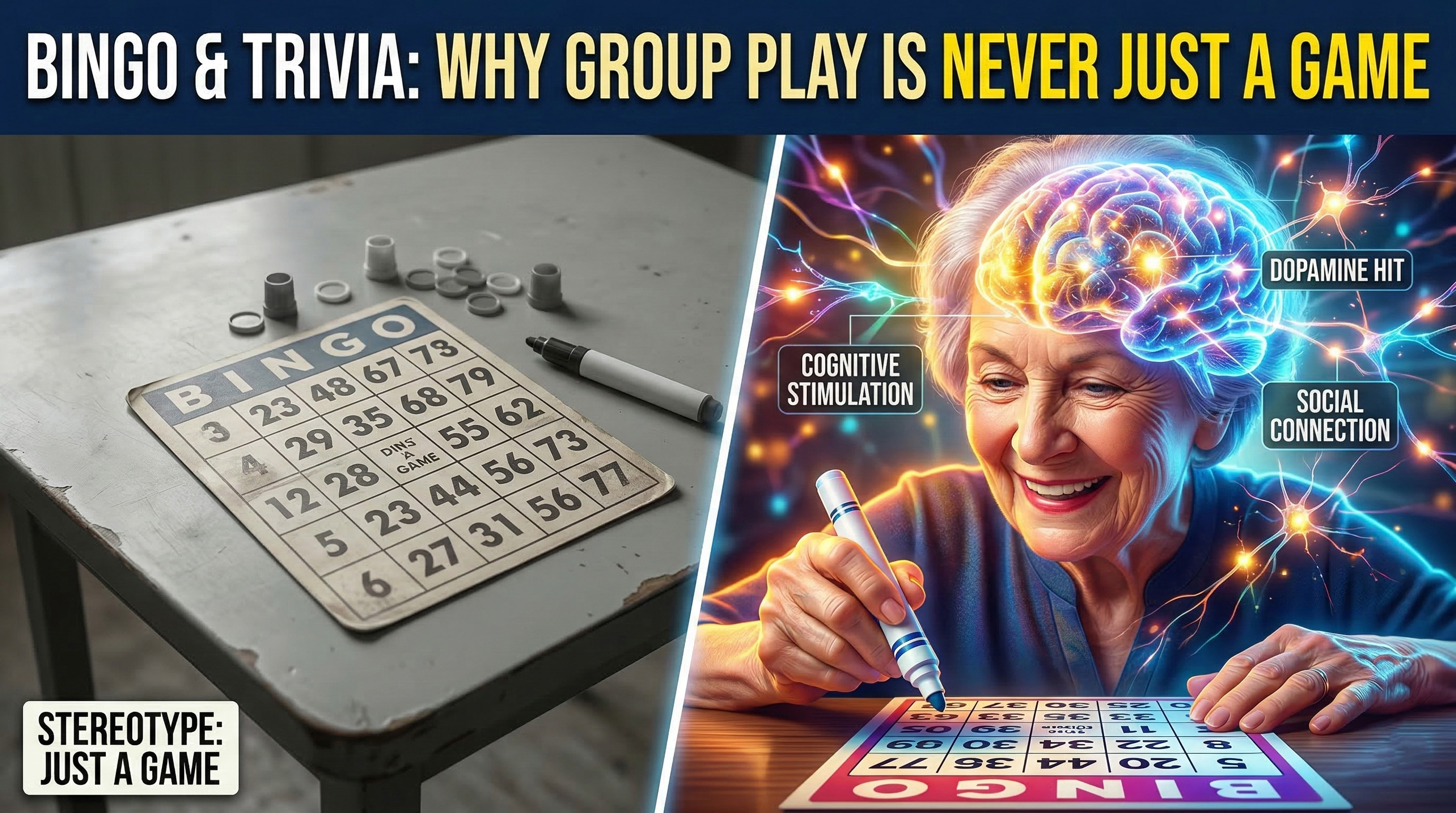
Contempt is not abstract. It has faces. It is the facility director who, in front of an evaluation committee, downplays Tuesday’s Bingo session to highlight Thursday’s “memory workshop”—more defensible in a funding application. It is the family caregiver who accompanies his mother to her residence and feels a dull embarrassment upon entering the game room, convinced he should “offer her something else.” It is the geriatrician who leaves these activities out of the clinical assessment because they appear in no validated cognitive-stimulation protocol.
This hierarchy rests on a rarely examined assumption: that an activity’s apparent complexity is proportional to its cognitive benefit. Chess would stimulate “more” than Bingo. Learning a language “more” than a general-knowledge quiz. The equation feels intuitive. Given the data currently available, it is also poorly supported. What determines the value of a cognitive activity for an older adult is not reducible to its perceived difficulty. We must also account for the engagement it actually elicits, the regularity with which it is practiced, and the participant’s capacity to access it without exhausting resources before even starting.
The Neural Mechanics of Bingo: What Happens in the Room
Let us take Bingo seriously—that is, at the level of its elementary operations. An active player carries out three tasks simultaneously. They process an auditory stimulus—the called number—engaging primary auditory cortex and associative areas in the temporal lobe. They execute a rapid visual scan of the card, recruiting visuospatial circuits in the posterior parietal cortex. They produce a motor response—marking the number—mobilizing motor cortex and the cerebellum in eye–hand coordination.
This perception–processing–action loop repeats every ten to fifteen seconds for thirty to forty-five minutes. Clinical neuropsychology calls this demand sustained attention: maintaining a stable level of vigilance on a prolonged task. It is among the functions most early affected in normal cognitive aging, and even more markedly in prodromal phases of dementing syndromes.
Bingo does not allow full autopilot. Its structure is repetitive, but its content is unpredictable—the player does not know which number will come next. Working memory intervenes continuously: holding the heard number long enough to locate it, while maintaining a representation of the card’s global state and the distance to a winning pattern.
Sobel (2001), in The American Journal of Alzheimer's Disease & Other Dementias, directly examined the impact of Bingo in patients with Alzheimer’s disease. The results indicate a significant improvement on recognition and attention tasks after regular game sessions. The study has methodological limitations—small sample size, no active control group—but it has the merit of documenting an effect in the target population itself, where many extrapolations stop at general theoretical models.
Dopaminergic Anticipation—and the Objection We Must Face
The neurologically most interesting moment in Bingo is not the win. It is the moment just before it. When a player realizes they are one number away, the mesolimbic dopaminergic system—linking the ventral tegmental area to the nucleus accumbens—shows a rise in activity. Schultz’s (1998) work on reward prediction established that dopaminergic neurons respond more strongly to the anticipation of a likely reward than to the reward itself. “I’m one away” is a neurobiological state, not merely an emotional tint.
Here we must name the obvious objection, because any informed reader will formulate it: this anticipation mechanism is exactly the one that underlies pathological gambling. Clark et al. (2009) showed that the near miss —the almost-win—activates the ventral striatum in a way comparable to an actual gain, and that this contributes to compulsive behavior in problematic gamblers.
The distinction rests on three structural parameters. First, financial stakes are absent or purely symbolic in residential contexts. Second, frequency is regulated—one to three sessions per week, supervised. Third, the social setting provides a regulatory function that solitary machine gambling cannot. Bingo in a residence and video poker in a casino may recruit comparable circuits, but under ecologically radically different conditions. Leaving this unaddressed would weaken the argument by omission. Addressing it strengthens it.
Trivia: Semantic Memory, Retrieval, and Identity Risk
Trivia mobilizes a different memory system. Answering a general-knowledge question draws on semantic memory—the reservoir of factual, lexical, and conceptual knowledge accumulated across a lifetime. This system is markedly more resistant to normal aging than episodic memory (Tulving, 1972; Nyberg et al., 2003). An 84-year-old may fail to recall an event from the previous week while accurately retrieving facts learned fifty years earlier.
The retrieval mechanism itself deserves attention. The “tip-of-the-tongue” phenomenon, studied by Burke, MacKay, Worthley, and Wade (1991), becomes more frequent with age. Trivia deliberately provokes this state: it forces the brain to search for information in semantic networks of the anterior temporal lobe, overcome access interference, and bring the content back into awareness. It is an exercise in active retrieval—comparable to strength training for a muscle that loses reactivity but not maximal capacity.
When retrieval succeeds in front of peers, the effect is double. Cognitively, the access route has been reinforced. Socially, the group recognizes that this person knows—that a lifetime has produced knowledge that remains operative. Atchley (1989) showed that maintaining a coherent cognitive identity protects against depressive withdrawal.
But what happens when the answer does not come? Public failure at Trivia can function as invalidation— a painful confirmation of a sensed decline. This risk is not marginal. It requires reflection on format. Team-based Trivia, where the answer emerges collectively, dilutes individual failure within the group. Competitive individual formats expose more. The choice is not trivial, and facilitators in these settings often know this empirically, even without the vocabulary to articulate it.
What Happens Between Players
Up to this point, the analysis has remained cognitive. Yet the title of this article also names the group, and here Bingo has a distinctive property: it imposes synchronous shared attention. During the calling of numbers, the entire room listens to the same stimulus at the same moment, often in the same silence. This involuntary perceptual synchronization—everyone waiting for the same input—creates what Launay, Dean, and Bailes (2013) describe as implicit interpersonal coordination: a temporal alignment of attentional states that fosters a sense of belonging.
Goffman would have spoken of a ritualized interactional frame. Seats are often fixed—each player returns to “their” chair. Verbal exchanges follow predictable scripts. The collective exclamation when someone wins functions as public ratification of the game and its stakes. What looks from the outside like repetitive routine is, for participants, a stable and legible social space—one in which they know how to be present. For older adults whose relational environment has often narrowed—fewer interlocutors, fewer opportunities for structured exchange—this ritual stability is not a defect. It is a condition of access to interaction.
The Entry Cost: Why “Easy” Is Not “Impoverished”
One parameter is still missing. Research on ego depletion and decision fatigue (Baumeister et al., 1998; Vohs et al., 2008) suggests that each effort to learn a new rule and each adjustment to an unfamiliar setting consumes limited executive resources—resources that, in adults over 75, decline with the physiological attenuation of frontal functions.
Bingo and Trivia share a rare functional property: their rules are already acquired. The procedural repertoire has been consolidated for decades. An older adult entering a Bingo room at nine in the morning—when chronobiological data place a relative peak in cognitive availability in older adults (Hasher, Zacks & May, 1999)—can devote the full share of their resources to play, interaction, and presence. The cost of appropriating the frame is near zero.
This is one reason why activities that look more “ambitious” on paper—digital workshops, strategy games, structured “brain training” programs—often fail to maintain regular participation among the oldest adults. Not because capacities are absent, but because the entry threshold absorbs resources before any benefit can emerge.
What Intellectual Honesty Compels Us to Say
Activating a neural circuit and producing a durable benefit are two distinct things. This article shows that Bingo and Trivia recruit identifiable cognitive functions—sustained attention, working memory, semantic retrieval, dopaminergic anticipation. It does not follow automatically that such recruitment slows cognitive decline or transfers to other daily-life functions.
Owen et al. (2010), in Nature, showed that computerized “brain training” programs produce improvements on the trained tasks but little or no transfer to general cognitive functions. The transfer question remains open for group games such as Bingo. What can be stated with more confidence is that these activities support regular engagement, provide multimodal stimulation in a social frame, and preserve a sense of competence—three factors that longitudinal studies on leisure activities, such as Verghese et al. (2003) in the New England Journal of Medicine, associate with reduced dementia risk.
Prudence does not weaken the argument. It makes it defensible.
The Question Behind the Question
Family caregivers who bring a parent home from Bingo often perceive—without finding the right words—that something has happened. A more alert gaze. Straighter posture. A more fluid conversation in the car on the way back. What they are observing is the behavioral trace of a brain recruited along multiple axes for a sufficient duration to shift, even temporarily, mood and vigilance. This is not sentimental. It is neurological.
One question remains. It does not target an abstract society. It targets the assessment form for the French APA care plan that has no field for “actively participates in a collective game twice per week.” It targets the daughter-in-law’s look when she enters the Bingo room and thinks, surely we could offer something else. It targets the medical coordinator who has never thought to ask a patient whether they stopped playing—and why.
If an activity can recruit the reward circuit, sustain attention, load working memory, exercise semantic retrieval, and generate social recognition for an 85-year-old—and we collectively decide that this person has done “nothing useful” with their morning—then the problem is not in the Bingo room. It is in the narrow, productivist, impoverished metric by which we still decide what a human being is supposed to be worth past a certain age—and in the fact that no one in the decision chain has ever taken the trouble to look at what is actually happening in the brain of the woman in the third row, marker hovering, waiting for someone to call 42.