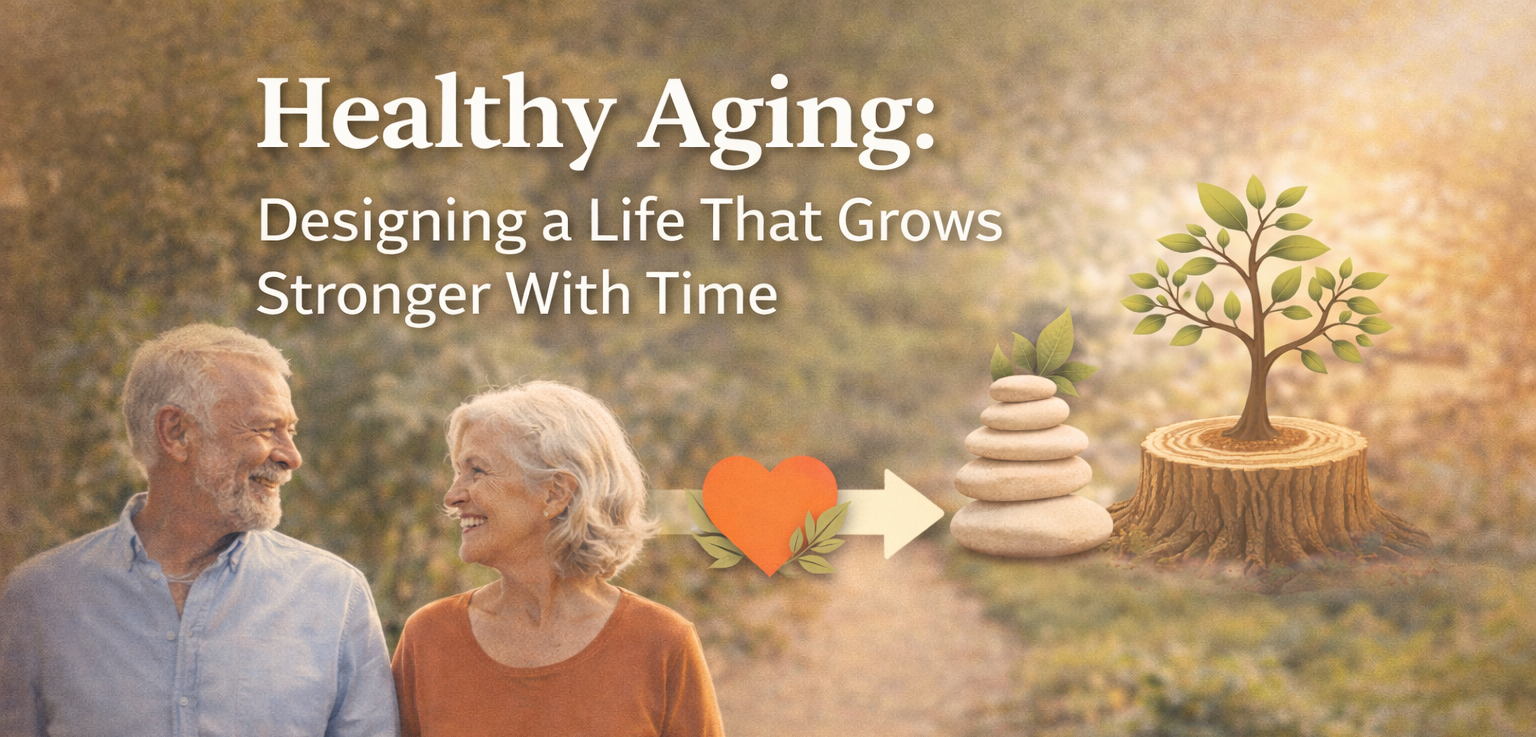
Healthy aging is not about avoiding birthdays.
It is about preserving strength, clarity, connection, and purpose as the years move forward.
For decades, aging was framed primarily through a medical lens, focused on decline and disease management. Today, researchers, gerontologists, and public health experts are shifting the conversation. Healthy aging is proactive. It begins long before crisis. And it is shaped daily by small, consistent behaviors.
The question is no longer simply, “How long will we live?”
It is, “How well can we live, for as long as possible?”
What Healthy Aging Really Means
The World Health Organization defines healthy aging as the process of developing and maintaining functional ability that enables well-being in older age. In simpler terms, it means maintaining the capacity to do the things that matter.
Researchers such as Dr. John Rowe and Dr. Robert Kahn, pioneers of the “successful aging” model, identified three key components:
- Low probability of disease and disability
- High cognitive and physical function
- Active engagement with life
More recent research builds on this framework, emphasizing not just absence of illness, but resilience, adaptability, and social integration.
Healthy aging is not perfection. It is preservation of function.
The Core Pillars of Healthy Aging
While genetics play a role, lifestyle and environment have profound influence over aging outcomes. Research across gerontology and longevity science consistently points to several foundational pillars.
1. Physical Strength and Mobility
Muscle loss, known as sarcopenia, accelerates with age and is closely linked to falls, frailty, and loss of independence. Strength training and regular movement remain some of the most evidence-backed strategies for preserving mobility and metabolic health.
Dr. Peter Attia and other longevity-focused physicians emphasize that muscle is one of the strongest predictors of long-term health outcomes.
Movement is not cosmetic. It is protective.
2. Cognitive Engagement
The brain thrives on stimulation. Lifelong learning, problem-solving, social interaction, and routine mental engagement are associated with better cognitive resilience.
Research on social connection by Dr. Julianne Holt-Lunstad has shown that isolation increases health risks significantly, reinforcing that cognitive health is deeply intertwined with community.
Healthy aging requires stimulation, not withdrawal.
3. Social Connection
Humans are social beings at every age. Community involvement, family relationships, and structured social engagement support emotional regulation and physical health.
Senior centers, volunteer programs, intergenerational initiatives, and digital communities increasingly serve as preventative infrastructure, not simply recreation.
Connection is not optional. It is foundational.
4. Daily Structure and Purpose
Retirement often removes built-in structure. Without routine, days can blur, which impacts mood, motivation, and cognitive sharpness.
Behavioral science suggests that predictable daily rhythms reduce anxiety and cognitive load. Simple anchors, morning routines, scheduled check-ins, and planned activities create stability.
Purpose may be one of the most powerful longevity tools available.
The Role of Technology in Supporting Healthy Aging
Healthy aging is no longer confined to clinical settings. Modern tools now extend support into everyday life.
AgeTech innovations include:
- Health monitoring devices
- AI-powered reminders and check-ins
- Telehealth access
- Digital social platforms
- Personalized wellness tracking
When designed with dignity and simplicity in mind, technology becomes an enabler of independence rather than a replacement for human care.
The most effective solutions do not overwhelm. They gently reinforce healthy behaviors over time.
Prevention Over Reaction
Traditional systems often respond after something goes wrong. A fall. A diagnosis. A hospitalization.
Healthy aging shifts the timeline.
Preventative support, strength maintenance, cognitive engagement, and community integration reduce the likelihood of crisis in the first place.
This approach does not deny the realities of aging. It prepares for them intelligently.
A Mindset Shift
Healthy aging begins with reframing the narrative.
Aging is not a problem to solve. It is a stage of life that can be supported thoughtfully.
It includes:
- Maintaining physical strength
- Protecting cognitive clarity
- Staying socially connected
- Preserving autonomy
- Designing meaningful daily routines
Longevity without vitality is not the goal.
The goal is living in a way that allows each decade to retain dignity, capability, and engagement.
Healthy aging is not about stopping time.
It is about using it well.