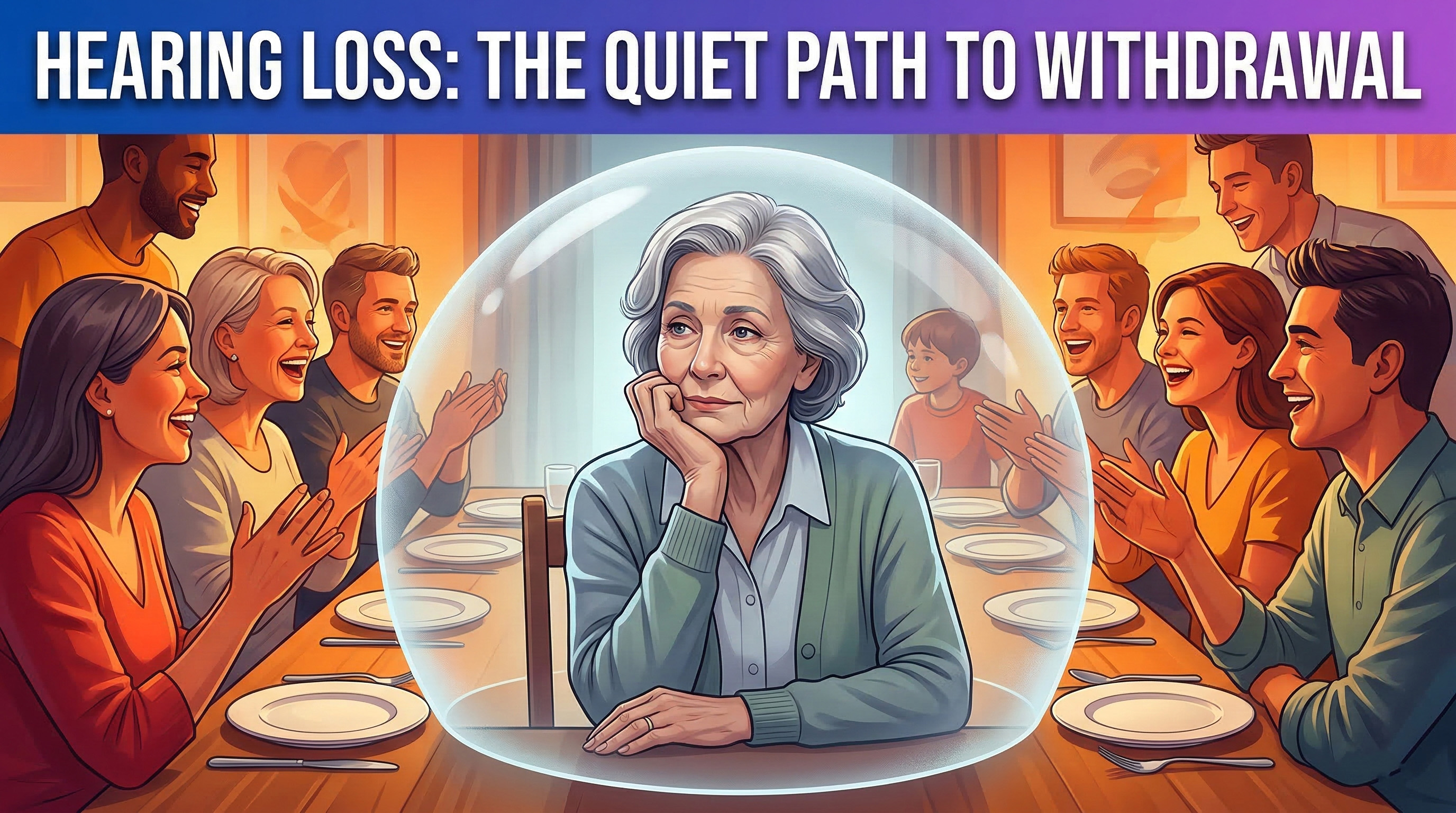
Hearing Loss Is a Social Disease: The Quiet Path to Withdrawal
Introduction
When we think of hearing loss, we tend to think of volume — a world turned down, a television set turned up. This framing, while intuitive, is dangerously incomplete. Hearing loss is not merely a sensory deficit; it is a condition that reshapes how individuals engage with the social world around them. It alters cognitive effort, emotional energy, social interpretation, and ultimately, behavior (established).
The consequences extend far beyond missed words. Over time, the strain of impaired hearing can quietly erode a person's willingness to participate in conversations, gatherings, and relationships. What begins as difficulty hearing in a noisy restaurant may end, years later, in near-total social withdrawal. This article examines the mechanisms through which that transition occurs — and what can be done to interrupt it.
1) Why Hearing Loss Looks Like "Personality Change"
Hearing loss is frequently invisible. Unlike mobility impairment or vision loss, it produces no outward sign. As a result, the behavioral changes it causes are routinely misattributed — not to a sensory problem, but to a change in personality, mood, or motivation (established).
Consider Margaret, 74, a retired teacher who once organized weekly dinners with friends. Over two years, she began declining invitations, especially to restaurants or large gatherings. She stopped attending her book club. Her daughter described her as "becoming more stubborn" and "losing interest in people." No one — including Margaret — connected these changes to the fact that she had been struggling to follow conversations in noisy environments for nearly three years.
This pattern is remarkably common. Family members and even clinicians may interpret withdrawal as depression, cognitive decline, or simply "aging." The underlying hearing difficulty remains undiagnosed or unaddressed, and the social consequences compound silently (citation needed).
2) The Mechanism: Listening Effort, Cognitive Load, and Fatigue
To understand why hearing loss leads to withdrawal, one must understand a concept known as listening effort — the cognitive resources a person must allocate to perceive and comprehend speech, particularly in degraded listening conditions. For someone with intact hearing, speech comprehension is largely automatic. For someone with hearing loss, it becomes an active, effortful task (established).
This effort recruits working memory, attention, and executive function — cognitive resources that are finite. The term cognitive load refers to the total demand placed on these resources at any given moment. When listening itself consumes a large share of that load, fewer resources remain for understanding meaning, formulating responses, or following the emotional nuances of a conversation (established).
The result is fatigue — not merely physical tiredness, but a specific form of mental exhaustion that accumulates across social interactions. Research in audiological science has consistently linked elevated listening effort with increased self-reported fatigue and reduced willingness to engage in further social activity (established). Over time, this fatigue becomes anticipatory: individuals begin to avoid situations they expect will be draining, even before the effort is exerted (hypothesis).
3) From Misunderstanding to Avoidance: The Behavioral Loop
The pathway from hearing difficulty to social isolation is not sudden. It follows a behavioral loop that reinforces itself at every stage.
First, effortful listening leads to frequent communication errors — misheard words, inappropriate responses, missed jokes. These errors generate social friction: embarrassment, awkwardness, or the perception of being ignored. Second, the person with hearing loss begins to internalize these experiences as personal failure rather than sensory limitation. Shame and self-consciousness develop (hypothesis).
Third, avoidance behavior emerges. The individual declines invitations, shortens conversations, or gravitates toward one-on-one interactions where listening is more manageable. Fourth, this reduced social participation diminishes the quantity and quality of social bonds, producing genuine isolation. The loop then deepens: isolation reduces communicative practice, which may further impair the ability to function in social settings (hypothesis).
Consider David, 68, whose wife noticed he had become "grumpy and distant" at family gatherings. She assumed he was unhappy or disengaged. In reality, David found large family dinners overwhelming — overlapping voices, background music, children's noise — and had begun sitting apart from the group to avoid the strain. His wife's frustration at his withdrawal only reinforced his reluctance to participate, and neither of them identified the hearing difficulty as the root cause.
This vignette illustrates a critical point: hearing loss does not only affect the person who has it. It reshapes the relational dynamics around them, often generating resentment or misunderstanding in caregivers and loved ones (established).
4) Hidden Consequences: Mood, Relationships, and Safety
The downstream effects of hearing-related withdrawal are substantial. Chronic social isolation is independently associated with increased risk of depression, anxiety, and cognitive decline in older adults (established). Several longitudinal studies have identified hearing loss as a significant modifiable risk factor for dementia, though the precise causal mechanisms — whether through cognitive load, social disengagement, or neural atrophy — remain under investigation (citation needed).
Relationships suffer as well. Communication is the infrastructure of intimacy, and when that infrastructure is degraded, misunderstandings multiply. Partners and caregivers often report frustration, emotional distance, and a sense of loss — not because affection has diminished, but because the channel through which it was expressed has narrowed (established).
There are also practical safety concerns. Individuals who withdraw from social networks lose access to informal monitoring — the neighbor who checks in, the friend who notices a change. Isolation thus compounds vulnerability in ways that extend well beyond emotional well-being (hypothesis).
5) What Helps (Without Overpromising)
Addressing hearing-related withdrawal requires intervention at multiple levels, and no single solution is sufficient.
Screening and early identification remain essential. Routine hearing assessments should be integrated into primary care for older adults, yet they are frequently omitted (citation needed). Earlier detection allows for earlier adaptation — before avoidance behaviors become entrenched.
Environmental modification can reduce listening effort significantly. Reducing background noise, improving room acoustics, and choosing quieter social settings are simple but effective strategies. These adjustments benefit not only the person with hearing loss but all participants in a conversation (established).
Communication strategies matter enormously. Facing the listener directly, speaking at a measured pace, and confirming understanding without condescension — these practices reduce cognitive load and preserve dignity. Caregiver education on these techniques is an underutilized resource (citation needed).
Access to and acceptance of hearing aids and assistive devices is another critical factor, yet uptake remains low among eligible adults. The barriers here are more psychological than technical: stigma, identity threat, denial, and the association of hearing aids with aging all contribute to resistance (established). Cost and access remain additional obstacles, particularly in underserved populations (citation needed). Addressing these barriers requires normalization, not persuasion — and framing hearing aids as communication tools rather than markers of disability.
Finally, psychosocial support — including counseling, peer groups, and family-based intervention — can help individuals and their networks understand and respond to hearing loss as a shared challenge rather than an individual failing (hypothesis).
Conclusion
Hearing loss is not merely a problem of volume or clarity. It is a condition that systematically increases the cost of social participation — cognitively, emotionally, and relationally. Left unaddressed, it sets in motion a quiet but powerful cycle of effort, fatigue, embarrassment, avoidance, and ultimately, isolation.
Recognizing this trajectory is the first step toward interrupting it. The responsibility does not rest solely on the individual with hearing loss; it extends to families, clinicians, and communities.
Key Takeaways:
- Hearing loss increases the cognitive effort required for everyday conversation, producing fatigue that accumulates over time and discourages social engagement.
- Behavioral withdrawal caused by hearing difficulty is frequently misinterpreted as personality change, depression, or disinterest — delaying appropriate intervention.
- A self-reinforcing loop of effort, error, shame, and avoidance can progressively lead to significant social isolation.
- Barriers to hearing aid adoption are primarily psychosocial — stigma, identity, and denial — not merely financial or technical.
- Effective intervention requires a combination of early screening, environmental adaptation, communication training, and psychosocial support — not technology alone.