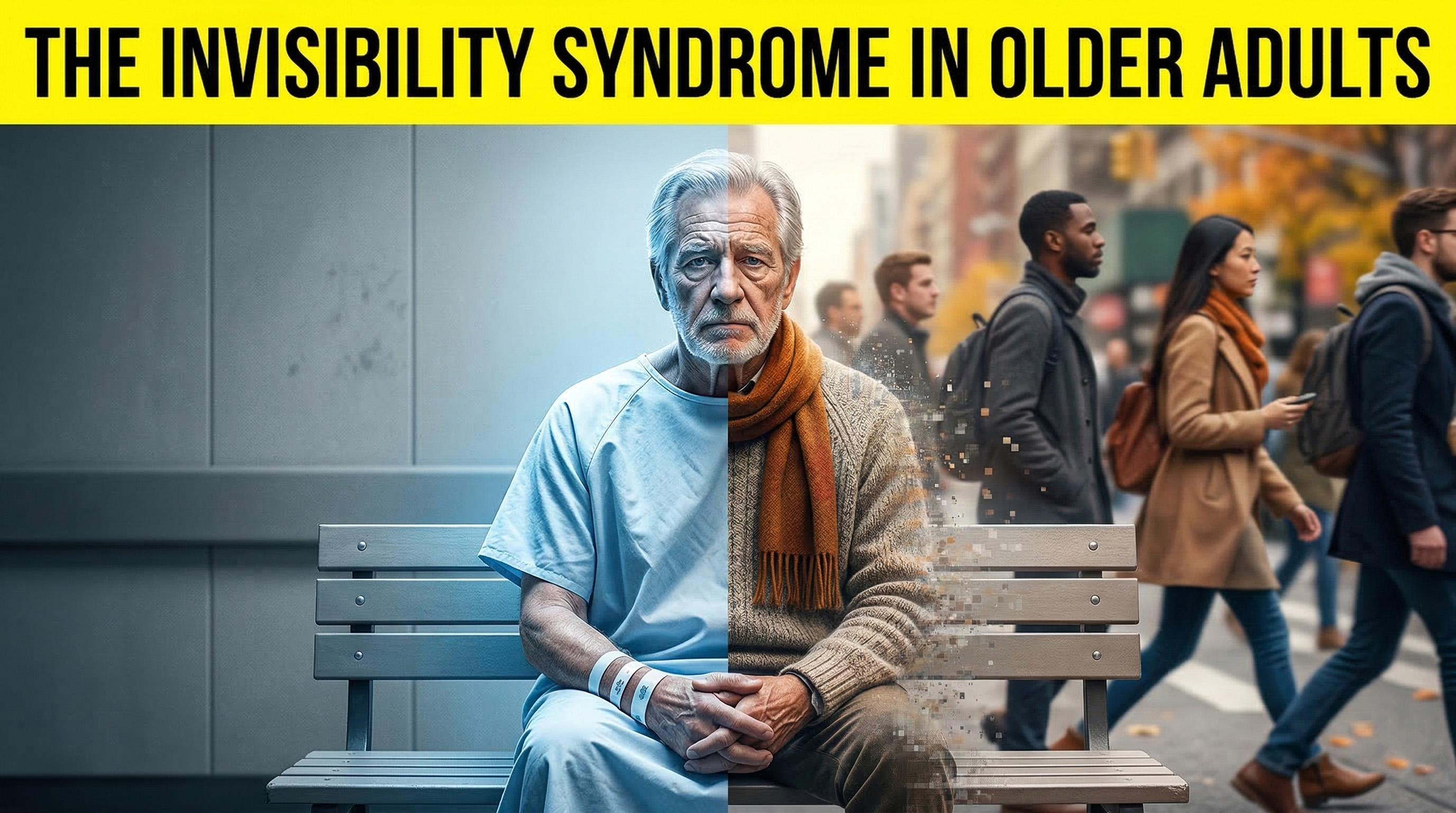
Contemporary aging cannot be reduced solely to its biological dimensions. For many individuals, advancing age is accompanied by a transformation of how society views them and a shift in relational dynamics. Work in gerontology and social psychology describes a process that goes far beyond material isolation: a progressive invisibilization of older adults within the social space.
The "invisibility syndrome" is not a recognized medical condition. Rather, it is a conceptual tool used to describe a frequently reported experience: the loss of recognition as a legitimate social subject who is heard and considered a full participant in collective life. The core issue here is less medical than it is sociological and psychological.
Ageism as an Explanatory Framework
Understanding this phenomenon relies primarily on the concept of ageism, introduced by Robert N. Butler in 1969. Ageism encompasses the stereotypes, prejudices, and discrimination directed at people based on their age.
According to the World Health Organization’s Global Report on Ageism (2021), roughly one in two people worldwide hold ageist attitudes. These societal representations have tangible impacts, directly influencing:
- Access to employment and career opportunities
- The quality and type of healthcare received
- Opportunities for civic participation
- Visibility and representation in the media
Ageism operates not only on a structural level but also internally. Becca Levy’s longitudinal studies have shown that internalizing negative stereotypes about aging has measurable effects on health. In a 2002 study, individuals with a positive perception of their own aging lived an average of 7.5 years longer than those with a negative perception. Other research links the activation of negative stereotypes to decreased memory performance.
These findings suggest that social representations of aging dictate not just subjective experience, but objective health indicators.
Medical Hyper-Visibility and Social Erasure
A distinct paradox characterizes contemporary societies: older adults are highly visible within the healthcare system, yet relatively absent from the public and decision-making spheres.
Aging is predominantly viewed through a biomedical lens focused on frailty and chronic pathology. The concept of "biomedicalization" helps explain this tendency to interpret age-related changes primarily in clinical terms. This orientation often leads to identity reduction, where an individual is defined first and foremost by their status as a patient.
Erving Goffman’s theoretical framework of stigma (1963) sheds light on this mechanism. When a single attribute becomes central to how an individual is socially evaluated, it can overshadow all other dimensions of their identity. Applied to aging, this process fosters heightened medical recognition at the cost of diminished social recognition.
Disaffiliation and "Social Death"
This identity reduction is part of a broader process that some sociological studies term "social death"—the gradual loss of social roles and symbolic recognition prior to biological death.
In gerontology, this phenomenon often manifests during major life transitions, such as retirement, a decrease in family responsibilities, or a loss of decision-making autonomy. While retirement can be a positive milestone, without new, socially valued engagements, it can trigger a symbolic rupture.
Data from major health studies highlight the severe consequences of this disaffiliation:
- Mental Health: Regular social participation is linked to a lower risk of depressive symptoms (SHARE survey).
- Mortality: Social isolation is associated with a significant increase in mortality risk (Holt-Lunstad et al., 2015).
- Brain Health: Social isolation is identified as a modifiable risk factor for cognitive decline (Lancet Commission on Dementia Prevention, 2020).
However, it is crucial to distinguish between symbolic invisibility and objective isolation, even though the two dimensions frequently fuel one another.
Cultural Representations and Levers for Action
Invisibilization is deeply rooted in media and cultural representations. Analyses consistently show an underrepresentation of older adults, as well as a tendency to associate them exclusively with decline or dependency. Margaret Gullette describes a "narrative of decline" that heavily structures Western imaginations of aging.
Conversely, research on successful aging and positive psychology suggests that embracing a plurality of representations promotes better psychosocial adjustment.
To actively reduce ageism and invisibility, interventions must be multi-layered. Effective strategies include:
- Combining educational initiatives with meaningful intergenerational contact
- Utilizing cognitive approaches to challenge and modify personal beliefs about aging
- Implementing policies that encourage citizen participation and inclusive employment for those who wish to work
- Promoting diverse, accurate, and positive media representations
Conclusion
The "invisibility syndrome" is not an individual failing; it is a complex psychosocial dynamic. It is the result of the interaction between cultural narratives, institutional organization, and the internalization of harmful stereotypes.
Empirical data clearly indicates that how a society frames aging directly impacts mental, cognitive, and physical health outcomes.
Reducing invisibilization requires coordinated action at the individual, institutional, and cultural levels.
If we want to build a healthier society, we must move beyond merely treating the elderly. We must ensure they are seen, heard, and valued.
Visibility is not just about inclusion. It is a fundamental pillar of public health.