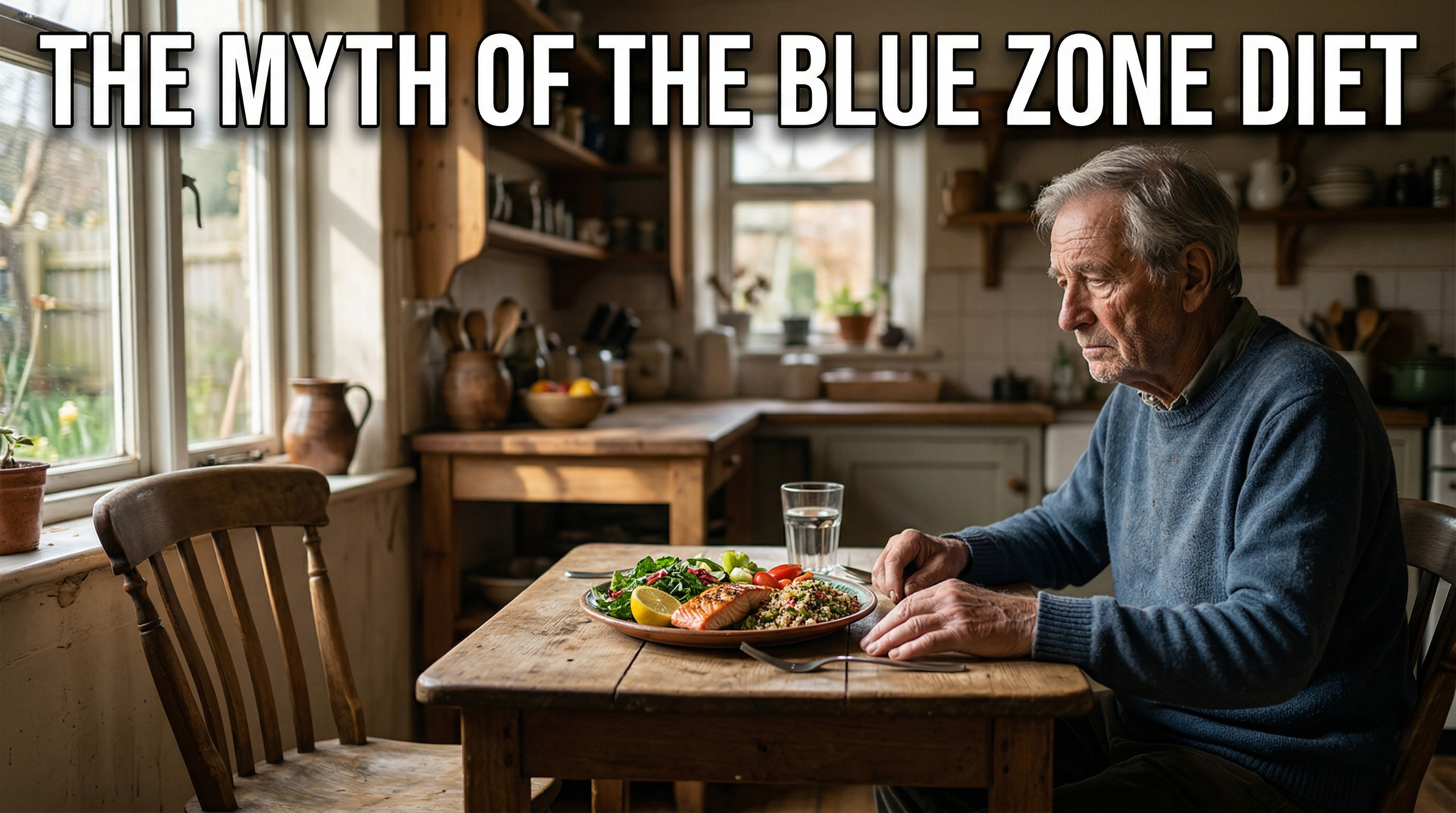
Every few months, a new article surfaces telling us the secret to living past 100 is olive oil, or wild-caught sardines, or a specific ratio of legumes to leafy greens. The wellness industry has turned the diets of Sardinian shepherds and Okinawan elders into a product category—cookbooks, supplements, meal kits. And well-meaning adult children absorb the message: if we just get the right groceries into Mom's kitchen, we've done our job.
But here's what the superfood gospel consistently ignores: an 85-year-old living alone with a fully stocked refrigerator can still be malnourished. The problem was never the grocery list. The problem is the empty chair across the table.
The Pathology of the Empty Table
Geriatricians have a clinical term for this: the "anorexia of aging." Extensively described by researcher John E. Morley beginning in the late 1990s, it refers to the physiological and psychological decline in appetite that accompanies advanced age. Hormonal shifts, diminished taste and smell, slower gastric motility—these factors conspire to make food less appealing. But the most potent appetite suppressant isn't biological. It's loneliness.
Research consistently links solitary eating in older adults to reduced caloric intake, poorer diet quality, and higher malnutrition risk. Older adults who regularly eat alone consume fewer calories, less protein, and less dietary variety than those who share meals—a finding replicated across multiple studies in gerontology and nutrition research, including work published in the Journal of the American Geriatrics Society and BMC Geriatrics. The mechanism isn't mysterious: when eating becomes a solitary act performed in silence in front of a television, it loses its social meaning. It stops being a meal and becomes a task. And tasks that bring no pleasure are easy to skip.
This is what the Blue Zones literature actually tells us, if we read past the ingredient lists. Dan Buettner's research identifies shared meals and strong social networks as core longevity factors—not because community is a nice addition to a good diet, but because community is the diet. In Ikaria, Greece, and Ogimi, Okinawa, no one eats alone. The table is where relationships are maintained, where the day has structure, where appetite is activated by conversation, laughter, and the simple presence of another person.
The Supply Chain of a Shared Meal
Recognizing this is one thing. Rebuilding it for a modern Western senior is another entirely.
The communal table that exists organically in a Greek village doesn't self-assemble in a suburb outside Chicago or a flat in East London. Today's aging adults are geographically separated from their families. Their social circles shrink through bereavement and mobility loss. And the professional care infrastructure around them—home aides, meal delivery services, visiting nurses—is organized around tasks, not togetherness.
Getting an older adult to eat well is, in practice, a coordination problem of surprising complexity. It means aligning grocery delivery with a home aide's schedule—and ensuring that aide has the time and the directive not just to prepare a meal but to be present during it. It means a daughter in another city knowing that Tuesday's lunch actually happened and wasn't scraped into the trash. It means a care manager understanding that a senior's weight loss isn't a menu failure but a signal of deepening isolation.
No single participant in the care ecosystem can solve this alone. The family member, the aide, the clinician, and the senior themselves each hold one piece of the picture. The challenge is making those pieces visible to one another.
From Task List to Shared Table
This is the infrastructure Agefully is built to provide. Rather than treating meals as isolated line items on a care checklist, Agefully gives every member of the care circle—family, professional caregivers, and the older adult—a shared operational view. Grocery needs, aide schedules, mealtime companionship, and observed changes in appetite or weight become connected data points instead of scattered concerns.
The goal isn't to medicalize the dinner table. It's the opposite: to de-medicalize it. When the logistics are handled—when the aide knows to stay, when the family can see what's happening, when patterns of skipped meals surface early—the meal itself can become what it's supposed to be. Not a clinical intervention. A human moment.
Important Medical Note: Sudden or significant weight loss, difficulty swallowing (dysphagia), or severe appetite loss in an older adult can indicate underlying medical conditions, dental problems, or medication side effects. These symptoms require evaluation by a geriatrician, speech-language pathologist, or clinical dietitian. A coordination platform supports the care ecosystem; it does not replace clinical expertise.
Stop Optimizing the Recipe. Fix the Table.
The wellness industry will keep selling us superfoods. And nutrition science matters—no one is arguing otherwise. But for the millions of older adults eating alone today, the most powerful nutritional intervention isn't a better ingredient. It's another person at the table.
We have to stop treating senior nutrition as a chemistry equation and start treating it as what it actually is: a social infrastructure problem. The meal is the medicine. But only if someone is there to share it.