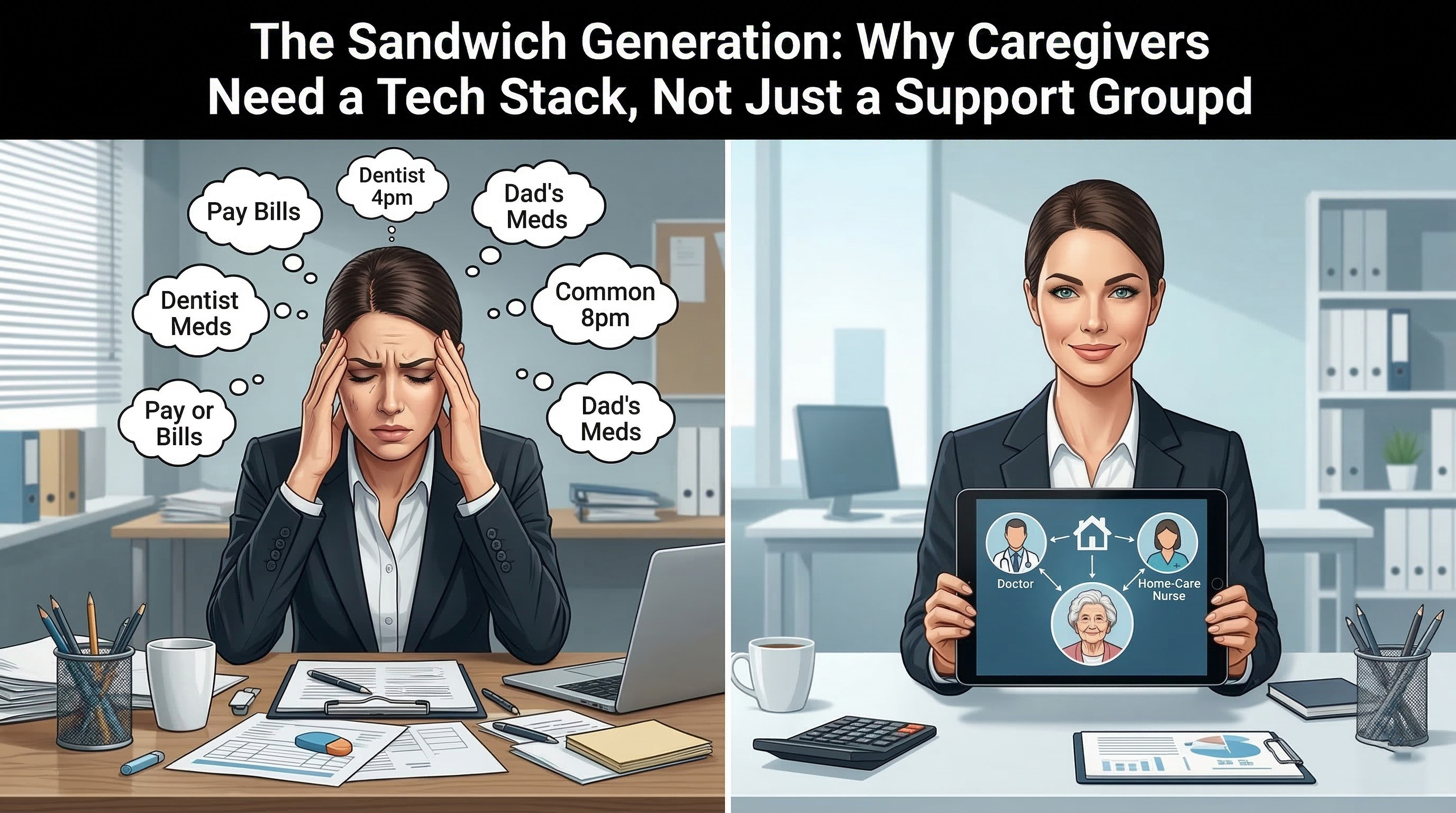
At 10:14 a.m., she is sitting in a budget review meeting, nodding at a quarterly forecast she has barely absorbed. What she is actually doing is texting her mother’s home-care nurse about a medication refill, checking whether her father made it to his cardiology appointment, and wondering if her son remembered his math test today. Her phone is face-down on the conference table, but her mind is split across three households, two generations, and at least six unanswered questions.
Nothing is on fire, exactly. That is the problem. Caregiving rarely arrives as a single dramatic emergency. It comes instead as a constant stream of loose ends, reminders, updates, forms, calls, passwords, refill dates, and low-grade dread. The crisis is not always acute. More often, it is administrative.
According to AARP’s most recent data, more than 53 million Americans provide unpaid care to an adult family member. Nearly a quarter of them are also raising children under 18. The National Alliance for Caregiving reports that these caregivers spend an average of 23.7 hours per week on care tasks — the equivalent of a part-time job layered on top of employment, parenting, and everything else adulthood already demands. They are often described as the “sandwich generation,” but that phrase sounds too neat for what the experience actually feels like. A sandwich is stacked. Caregiving is scattered. It turns ordinary people into unpaid project managers of other people’s lives, responsible for coordination, oversight, emotional regulation, contingency planning, and follow-up, often with no training and no real backup.
What wears them down is not simply love, grief, or duty. It is the relentless administration of care.
The Invisible Burden
Most people assume caregiving is exhausting because of the visible tasks: driving to appointments, managing meals, helping with bills, sitting in waiting rooms, making late-night pharmacy runs. Those things are real, and they matter. But ask caregivers what truly drains them, and the answer is often harder to photograph or explain. It is the mental load.
The mental load is the burden of having to remember everything, track everything, anticipate everything, and notice what everyone else has missed. It is knowing which doctor said what, when the home aide is coming, whether the facility ever called back, which sibling is dependable under pressure, which child needs to be picked up at 5 p.m., and whether Mom sounded more confused than usual during yesterday’s call. It is not one job. It is fifteen jobs running in parallel, all in the background, while the caregiver is still expected to show up to work, answer emails, buy groceries, and function as if their attention were not permanently divided.
A 2020 study published in The Gerontologist found that family caregivers reporting high coordination burden were significantly more likely to experience clinical-level anxiety than those whose care responsibilities were physically demanding but logistically simpler. That distinction matters. The breaking point is often not the heaviness of a single task. It is the cognitive strain of holding the entire system in your head and knowing that if you drop one thread, something important may unravel.
That burden grows heavier because the information itself is fragmented. One update is buried in a sibling group text. Another is sitting in an email from a care agency. A medication list exists as a photo in someone’s camera roll. A specialist’s recommendation lives on a discharge sheet left on the kitchen counter. A calendar reminder exists, but only on one person’s phone. Everyone is technically communicating, yet no one has a full picture. This creates a very specific kind of stress: not the stress of doing too little, but the stress of never being fully certain that you have not missed something important.
Support groups can absolutely help. They offer validation, perspective, and emotional relief. They remind caregivers that their exhaustion is not a personal failure. But a support group does not reconcile medication lists, connect appointment outcomes to the rest of the care plan, or reduce the number of disconnected channels through which care is managed. Emotional support matters deeply. Operational support matters too.
The B2B2C Solution — Breaking the Silos
This is where many caregiving apps, despite good intentions, fall short. They are built for the consumer alone, as though caregiving exists inside a closed family loop. A reminder app on a daughter’s phone may help her personally, but it does nothing to connect her to her father’s home-care agency, her mother’s assisted living staff, or the specialist who changed a prescription last Tuesday. The silos remain. The daughter remains the bridge.
But real care does not happen in a closed loop. It happens across a network: family members, professional caregivers, agencies, senior living staff, clinicians, and the older adult themselves. When technology serves only one node in that system, it may be useful, but it does not solve the structural problem. Caregivers do not need another personal organizer. They need shared infrastructure for the care ecosystem around them.
That is the difference a B2B2C model can make. A platform like Agefully is designed to sit at the intersection, connecting aging adults, families, and professional care teams in one shared environment. When that connection works, updates become visible instead of hidden in private channels. Responsibilities become clearer. Decisions become easier to trace. Coordination becomes lighter because it no longer depends on one exhausted person acting as the human router for everyone else.
In practice, that kind of caregiving tech stack is not about adding more noise. It is about replacing chaos with continuity. It creates a shared source of truth for medication changes, appointment outcomes, daily status updates, and professional observations. It replaces scattered texts and voicemails with contextual communication tied to the person receiving care. It distributes tasks across the network instead of letting them pile up on one family member’s mental desktop. A strong system does not merely remind people to cope better. It reduces the number of things they have to manually hold together in the first place.
That matters psychologically as much as practically. Anxiety thrives in gaps: gaps in knowledge, gaps in response time, gaps between what is happening and what the caregiver can verify. When information flows more cleanly, uncertainty shrinks. The caregiver no longer has to spend half the day hunting for updates or wondering whether silence means stability or simply a missed message. That shift is not cosmetic. It changes the emotional texture of caregiving itself.
A fair concern, of course, is whether older adults can realistically engage with these tools, or whether platforms like this risk introducing surveillance where there should be trust. These are serious tensions, and any responsible AgeTech company has to confront them directly. That means intuitive design, clear consent, and systems that give older adults visibility into their own care instead of treating them as passive subjects of monitoring. Technology that excludes, confuses, or infantilizes the person at the center is not a solution. It is just a more modern form of the same old problem.
Redefining the Relationship
When logistics are unmanaged, the relationship between parent and adult child can quietly deteriorate into permanent supervision. Every call becomes a check-in. Every visit becomes a troubleshooting session. Every conversation circles back to prescriptions, appointments, falls, bills, paperwork, or who said what last week. Love is still present, but it starts to live underneath coordination.
Most caregivers never consciously chose to become case managers for the people who raised them. They stepped into that role because the system left a vacuum, and someone had to hold it together. Technology cannot erase the emotional complexity of aging, decline, role reversal, or family tension. But it can reduce the administrative drag that turns caring into clerical labor.
That is the real promise of connected AgeTech. It lets the daughter stop spending dinner refreshing three message threads. It lets the son stop carrying the entire family timeline in his head. It gives caregivers room to use their energy for judgment, affection, advocacy, and presence instead of pure coordination. It allows them to ask their mother how she is feeling, not just whether she took her medication. It allows them to show up as family again, not only as managers of risk.
The future of aging will not be secured by asking families to absorb more and smile through it. It will depend on whether we finally acknowledge who is holding the system together and build around their reality. The sandwich generation does not need more praise for being resilient. It needs infrastructure worthy of the work it is already doing.
Caregivers have spent years acting as invisible operating systems for everyone else. The next step is not to tell them to cope better. It is to give them tools that finally share the load — because when caregivers are forced to carry the entire system alone, the system is already failing.