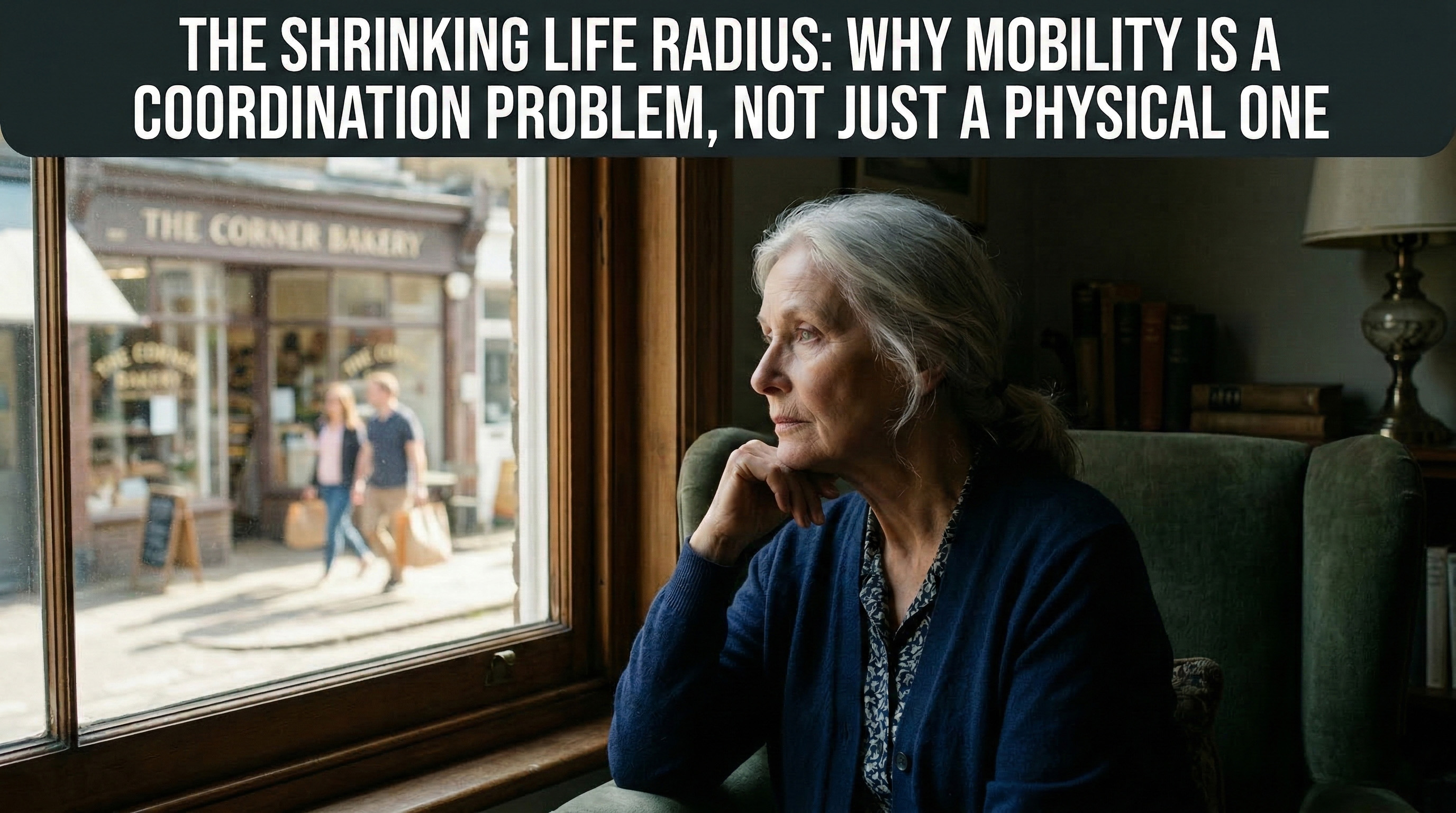
The Geography of Aging
It rarely starts with a fall. More often, it starts with an errand that quietly disappears.
One Sunday, your mother decides the neighborhood supermarket is "too far for not much." She orders another way. No one worries. A few weeks later, she stops walking down to the mailbox at the end of the driveway. Then the garden becomes a place she looks at from the window, no longer a place where she gets her hands in the soil. Finally, there's the chair. Not as a dramatic symbol, but as a fallback point: somewhere she sits "for a bit," then "quite often," then where she ends up organizing her entire day.
Aging doesn't strike like a storm. It settles in more like a receding tide: the accessible world can contract gradually, circle after circle, until it holds only a few meters, a few routes, a few habits. This geographic contraction is rarely spectacular. It is, on the contrary, calibrated to go unnoticed — especially by the people who love the person most.
The "Life Radius": An Underestimated Metric
We too often reduce walking to a physical health indicator: step count, heart rate, calories. These metrics can be useful, but they miss what matters most. Walking isn't just exercise; it plays a central role in autonomy, social exposure, cognitive stimulation, and the emotional regulation of everyday life.
Walking to the bakery isn't "working out." It's running into a neighbor, exchanging three words, feeling the cold air, negotiating an uneven sidewalk, making a micro-decision at every intersection. That unremarkable seven-minute trip engages spatial orientation, balance, attention, micro-decisions, and social interaction. When it disappears, it isn't just a distance that closes — it's an entire set of daily stimulations that shuts down.
In gerontology, the concept of life-space mobility aims precisely to measure where a person actually moves: within the home, around the home, in the neighborhood, beyond — and with what level of assistance. Foundational research has shown that this measure is linked to functioning and can capture meaningful changes over time.
When the life radius shrinks, risks can increase: less activity, less confidence, sometimes more isolation — and a more favorable terrain for falls. Falls among adults 65 and older are a major public health concern, and recommended approaches emphasize identifying modifiable risk factors and intervening early.
The Information Gap: The Signals Exist, but They Don't Travel
Here is the cruelest part: the people best positioned to observe the shrinking of a life radius are rarely the ones who can trigger a response.
The adult child visits once a week, or once a month. They find their mother sitting, smiling, the television on. "She looks fine. A little tired, maybe." They leave reassured. What they don't see is that on Tuesday morning, the home aide noticed she was gripping the hallway wall to reach the bathroom. That the physical therapist noted a decrease in range of motion or shakier balance than the month before. That on Friday, the shutters were still closed at 2 p.m. because "going out to the garden is complicated today."
These weak signals exist. They are often captured. But they remain siloed: in each caregiver's head, in a file that isn't shared, or in a minimized phone comment ("nothing serious"). The family receives a general impression — often incomplete. And the system frequently reacts only after the visible event: the fall, the fracture, the hospitalization. By that point, the life radius may have collapsed, and rebuilding it costs infinitely more energy than maintaining it would have.
Why Mobility Becomes a Coordination Problem
Preserving a life radius is not a standalone medical act. It is an ongoing coordination effort.
The physical therapist needs to adjust based on what's actually happening between sessions. The home aide needs to be not just "present," but present at the right time to support a simple, safe outing. The family needs to understand the functional trajectory — not as an opinion ("she's fine / she's not fine"), but as concrete observations ("she now avoids the walkway," "she holds onto the wall," "she stops going out after 11 a.m."). Sometimes it takes micro-decisions: changing the time of a walk, simplifying a route, adding an accompaniment, adapting a support point.
Consumer tools can document a drop in activity. But a drop in steps doesn't explain why: pain? fear? medication fatigue? weather? unstable shoes? avoidance of a specific spot? Without context, data becomes a photograph. What's missing is the operation: the bridge from observation to action.
Why Shared Coordination Can Slow the Shrinking of a Life Radius
Maintaining a life radius often depends less on "motivation" than on the flow of information: who observes what, at what moment, and how those observations trigger a simple action.
Shared coordination can help to:
- Capture weak signals — a new difficulty on a familiar route, more frequent pauses, avoidance.
- Cross-reference observations between professionals and family to distinguish a "bad day" from a trend.
- Trigger micro-adjustments — accompaniment schedules, route adaptation, simple home modifications, revised goals.
- Reduce the family's mental load by replacing scattered exchanges with a structured coordination thread.
Agefully is built on this logic: shared coordination between loved ones, professional caregivers, and the person being supported — without substituting for medical assessment or clinical prescriptions.
What to Do This Week: 7 Simple Actions to Keep the World from Shrinking
- Establish a life-radius baseline: which locations were reached in the past week (room → garden → mailbox → street corner → store)?
- Choose two "minimum viable" outings: short, easy, repeatable (e.g., mailbox + five minutes outside).
- Define one weak signal to monitor: new need for support, pauses, route avoidance, unusual fatigue.
- Sync the team: ask the home aide or PT for one factual observation per week (one sentence, not an essay).
- Reduce friction: clear pathway, lighting, stable shoes, grab points, choose the time of day when energy is highest.
- Add one accompanied walk per week: the goal is confidence and regularity, not performance.
- Set an escalation trigger: in case of sudden change (dizziness, near-fall, acute confusion, severe pain), contact a healthcare professional.
Important Medical Disclaimer: Mobility loss can be a symptom of serious underlying conditions — neurological, cardiovascular, musculoskeletal, medication side effects, among others. An article or a coordination platform does not replace a medical diagnosis, a geriatric assessment, or a supervised rehabilitation protocol. Any notable, rapid, or concerning decline in mobility should prompt a medical consultation, particularly if accompanied by falls, faintness, dizziness, confusion, or significant pain. Technology organizes the care; clinicians diagnose the patient.
The Real Measure
We measure aging in years. It's a convenient convention, but often not a very informative one. An 82-year-old who walks to the market, picks out her tomatoes, waves to a neighbor, and takes the longer way home because it runs under the plane trees — inhabits a vast world. A 74-year-old whose universe fits between the bed, the armchair, and the kitchen — inhabits a world that is closing in.
The useful question isn't just "how old is she?" but "how large is her world today?" And above all: "what are we doing, concretely, collectively, to make sure that world doesn't shrink tomorrow?"
The answer will rarely come from one heroic caregiver. It will more often come from a coordinated system — family, aides, therapists, clinicians — sharing the same information, the same intention, and the same ground of action. Because a life radius doesn't hold on its own. It holds through organization.
Sources:
• Life-space mobility (life radius measurement) — UAB Study of Aging / Life-Space Assessment
• Fall prevention — CDC STEADI Initiative
• Social isolation and health — National Academies Report, 2020