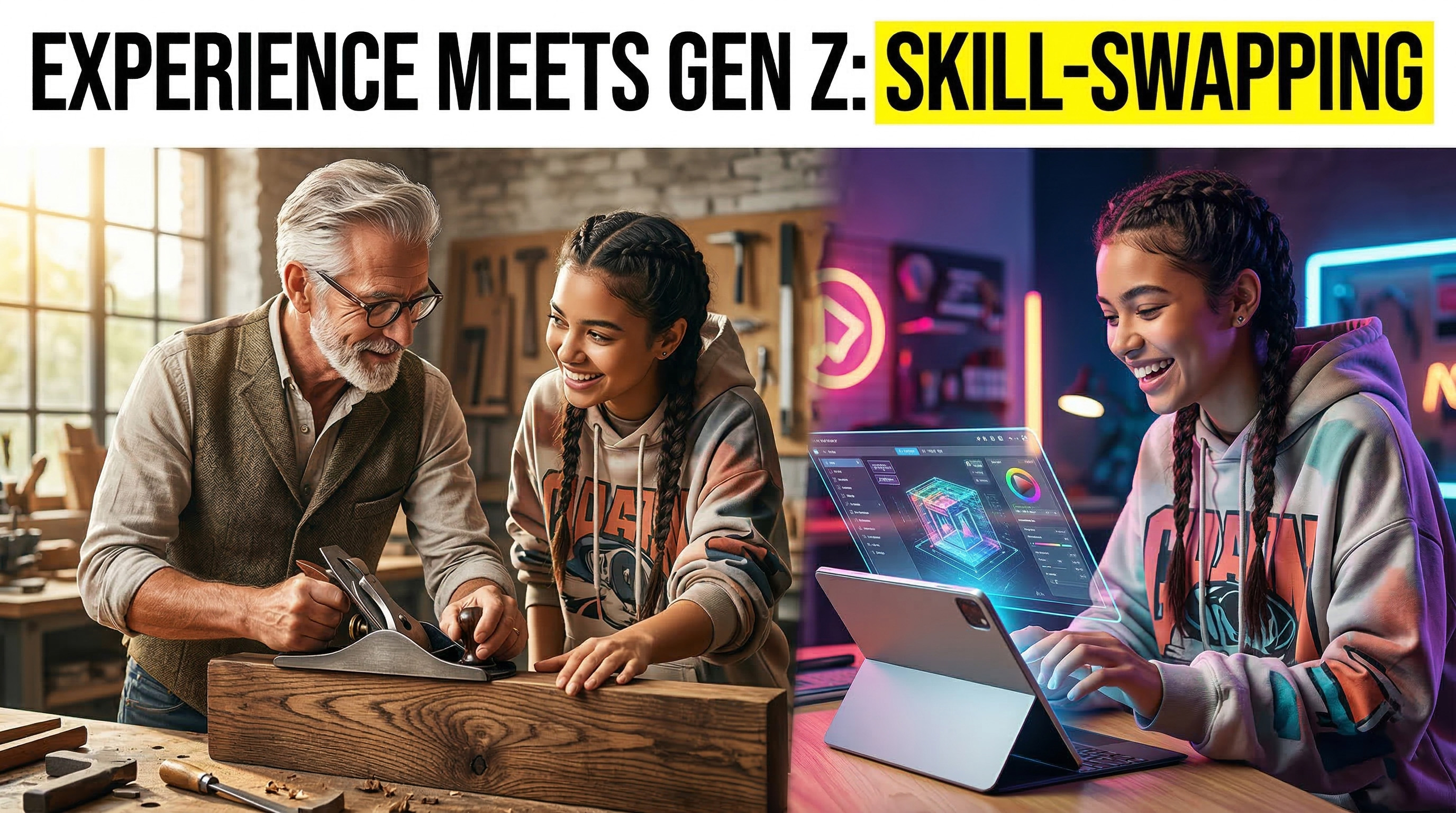
When Experience Meets Gen Z: The Social Value of Intergenerational Skill-Swapping
Introduction
Contemporary discourse on aging in digital societies tends to position older adults primarily as recipients of knowledge transfer, especially in matters of technological competence. Public libraries offer "tech help for seniors," community centers host smartphone tutorials, and family narratives often revolve around younger relatives patiently explaining apps to their elders. Although well intentioned, this framing establishes a unidirectional model of intergenerational learning that obscures a more complex reality: older adults possess substantial reserves of embodied, practical, and experiential knowledge that remain relevant and are often inaccessible to younger cohorts.
Intergenerational skill-swapping proposes a different model of exchange. Rather than casting one generation as teacher and the other as perpetual learner, it creates reciprocal relationships in which competencies flow in both directions. A seventy-year-old may learn to navigate digital banking while teaching garment repair; a twenty-five-year-old may share coding basics while learning furniture restoration. This reciprocity alters the social meaning of the exchange, shifting it from charitable assistance to genuine collaboration between people who recognize one another’s agency and expertise.
At the same time, any serious analysis of such exchanges must examine their conditions: who participates, whose knowledge is recognized, and whether the language of reciprocity can sometimes conceal persistent inequalities. This article explores both the promise and the complications of intergenerational skill-swapping as a social practice.
The One-Way Learning Myth
The assumption that knowledge transfer in contemporary society flows mainly from young to old reflects a broader cultural tendency to equate technological novelty with social value. This perspective elevates familiarity with current digital interfaces while devaluing forms of knowledge that resist easy codification or rapid obsolescence.
Survey research consistently documents this asymmetry in perception. The European Social Survey’s work on ageism shows that younger respondents often associate aging with technological incompetence while underestimating older adults’ expertise in other domains. Studies of intergenerational family dynamics suggest a similar imbalance: technology-related assistance often flows from adult children to parents, while practical help such as home repair, childcare, or financial advice frequently moves in the opposite direction without receiving the same recognition as "knowledge transfer."
This framework is sociologically incomplete for several reasons:
- It conflates recent acquisition with relevance: A twenty-year-old’s fluency with social media algorithms does not reduce the value of a seventy-year-old’s understanding of small engine repair; they belong to different knowledge domains with different uses.
- It overlooks power relations: The perceived value of knowledge reflects power relations, not just utility. The familiar contrast between "digital natives" and "digital immigrants" has created an environment in which one form of literacy overshadows others and receives disproportionate symbolic recognition.
- It reinforces ageist assumptions: Most importantly, the one-way model assumes cognitive decline and lack of adaptability. It positions older adults as standing outside zones of competence rather than as individuals with differentiated portfolios of strengths and limitations.
The Value of Embodied and Practical Knowledge
Older adults often possess what Michael Polanyi termed tacit knowledge: competencies that cannot be fully articulated through explicit instructions and instead require demonstration, repetition, and apprenticeship-style transmission. His distinction between "knowing how" and "knowing that" is especially useful here. Tacit knowledge is procedural and embodied; it lives in practice more than in explanation.
Such competencies may include:
- Manual trades: Carpentry, plumbing, and electrical work.
- Domestic crafts: Sewing, tailoring, and pattern-making.
- Culinary techniques: Preservation, fermentation, and regional cuisines.
- Mechanical knowledge: Engine repair and tool maintenance.
- Horticultural practices: Developed through long-term observation of local growing conditions.
Yet it would be analytically naive to treat older adults as a homogeneous group of skill-holders. The competencies individuals possess are shaped by class background, gendered divisions of labor, occupational history, and cultural context. A retired autoworker in Michigan possesses different tacit knowledge from a former accountant in the same city. Migration history adds further complexity: older immigrants may possess valuable knowledge of crafts, cuisines, and agricultural practices from their countries of origin, yet face linguistic barriers or limited social recognition that prevent this knowledge from circulating.
Economic changes over recent decades—especially the decline of vocational education, the offshoring of manufacturing, and the growth of service economies—have weakened the institutional transmission of practical knowledge while increasing its scarcity. Younger cohorts may hold advanced degrees while lacking basic competencies in household repair or food preservation, because these skills are neither formally taught nor economically valued in their formative environments. Research from the UK’s Social Mobility Commission has documented the declining availability of craft apprenticeships since the 1980s, contributing to generational gaps in practical skill transmission.
Even so, practical caution is needed. Not all forms of older adults’ knowledge are equally valuable or equally desired in the present. Some skills, such as operating obsolete industrial equipment, may have limited contemporary application. Others are so strongly gendered that celebrating them uncritically risks reproducing old divisions of labor.
Intergenerational Reciprocity: Conditions and Complications
The sociological importance of skill-swapping lies in its reciprocal structure. Unlike volunteer models in which older adults merely receive assistance, or mentorship models in which elders simply dispense wisdom, bidirectional exchange is based on mutual recognition: each party possesses something the other lacks and values.
When a retired electrician teaches a graduate student to rewire a lamp while learning to use video-calling software in return, both participants leave the exchange having contributed something of value. For older adults, the opportunity to teach reinforces what Erik Erikson described as generativity: the sense of contributing to subsequent generations. For younger participants, such exchanges disrupt common assumptions about aging and competence, challenging the culturally dominant idea that aging is defined mainly by decline.
Still, genuine reciprocity cannot be assumed. Power asymmetries may persist even within nominally reciprocal arrangements. Digital literacy carries considerable practical weight in contemporary life; an older adult who lacks such literacy may enter an exchange under conditions of urgency, while the practical skills they offer are treated by younger participants as optional or recreational.
Participation itself is also unequally distributed. Transportation to community spaces, physical ability, confidence, and access to networks are all shaped by class, health status, and social capital. Furthermore, the language of "exchange" can obscure the labor involved. When older adults teach skills without compensation in settings where professional instruction would otherwise be paid, they are performing a form of unpaid productive work.
Real-World Examples
Several existing models illustrate both the viability and the limits of intergenerational skill exchange:
- The Repair Café movement: Founded in Amsterdam in 2009 and now active in more than 2,500 locations worldwide, bringing together people with repair skills and those with broken household items.
- Lake Erie Makers (Cleveland): Explicitly structures programming to encourage age-diverse collaboration, where older members with machining backgrounds work alongside younger participants familiar with digital fabrication.
- Mehrgenerationenhäuser (Germany): Multi-generation houses across more than 500 community sites that include skill-sharing among their core activities, depending on stable funding and local interests.
- Time banking (Dane County, Wisconsin): Enables older adults to exchange skills such as tax preparation or automotive advice for help with digital tasks or physically demanding labor, using formal time credits.
What these examples share is that they are organized around genuine use rather than primarily therapeutic intent, fostering authentic interdependence.
Challenges and Limitations
A realistic assessment must acknowledge the barriers to wider adoption of intergenerational skill exchange:
- Logistics: Transportation, scheduling across different daily rhythms, and access to suitable physical spaces.
- Communication friction: Cohort-based differences in attitudes toward authority, formality, autonomy, and pacing.
- Persistent stereotypes: Younger people may underestimate older adults’ abilities or communicate with condescension, while older adults may hold preconceived judgments about younger people's work ethic.
- Coordination: Aligning specific competencies with specific interests is difficult in smaller, rural, or highly transient communities.
Finally, the celebration of intergenerational skill exchange must not become an excuse for institutional retreat. Public investment in practical education, accessible digital training, and adequately funded senior services remains essential.
Conclusion
Intergenerational skill-swapping deserves attention not as a heartwarming novelty, but as a serious social practice with implications for how contemporary societies organize knowledge, structure age relations, and assign value to different forms of expertise. By privileging reciprocal exchange over one-way assistance, it challenges dominant narratives that position older adults mainly as knowledge recipients.
Its significance extends beyond the acquisition of particular skills. It includes the recognition of older adults’ continuing agency, the disruption of age-based stereotypes, and the creation of relationships across generational divides. However, realizing its promise requires sustained attention to the concrete conditions under which exchange takes place, to who is able to participate, and to whether the rhetoric of reciprocity is matched by the realities of practice.