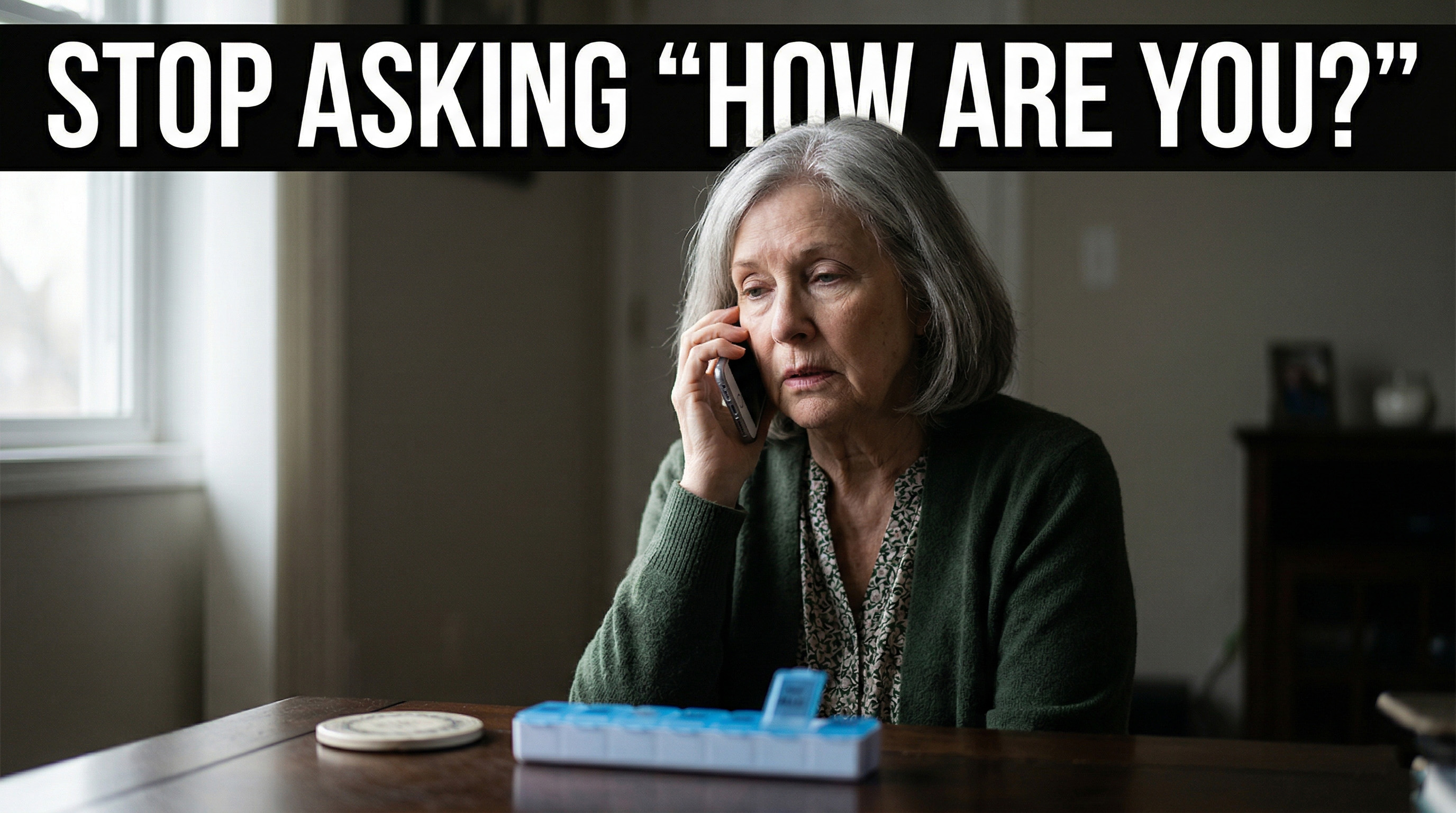
The phone rings at 4 p.m., right on schedule. An aging mother picks up, already knowing what comes next. "Hi, Mom. How are you?" She pauses. The knee still aches. Sleep was broken again at 2 a.m. The new medication makes her dizzy. She gives the only answer that protects her dignity and spares her child from worry: "I'm fine." Both of them sense it is not entirely true. Neither knows what else to say. The call lasts six minutes.
This kind of exchange is remarkably common among families managing care across distance. Adult children call their aging parents out of love, out of genuine concern, and often out of a desire to feel useful when proximity is not possible. But the question they lead with may be one of the least productive questions a person managing chronic pain, fatigue, or cognitive change can face. It asks for a medical summary. It asks a human being to compress the fullness of their day into a symptom report. And it quietly communicates something neither party intends: that the only thing worth discussing is what is going wrong with the body.
Over time, this pattern can quietly reshape the relationship. When every phone call orbits around blood pressure readings, therapy appointments, and whether pills were taken on time, something shifts. The parent gradually stops being the person who taught you to ride a bike, who argued about politics at Thanksgiving, who had strong opinions about architecture or jazz or the neighbor's dog. They begin to feel, in the context of these calls at least, like a patient. The child, meanwhile, starts to feel less like family and more like a remote care manager running through a checklist.
This is not a failure of love. It is, in many cases, a failure of infrastructure. Families default to medical questioning because they often have no other reliable source of daily information. If you live hundreds of miles from your mother, the phone call may be your only window into her world. So you ask the questions that feel most urgent: Did you eat? Did you fall? Did the aide show up? The conversation becomes a checklist, and over months or years, the checklist begins to crowd out everything else.
The effects of this dynamic deserve attention. Research in person centered care has long emphasized that older adults retain a stronger sense of wellbeing and identity when they are engaged as whole people, not primarily as medical cases. When someone begins to feel that their family sees them only through the lens of decline, it can affect their willingness to engage, their sense of self, and even their desire to answer the phone. The very tool meant to preserve connection risks becoming the thing that quietly erodes it.
To be clear, logistical and medical questions are not the enemy. They matter. Knowing whether a parent has eaten, whether they are in pain, whether their medication schedule is on track: these are acts of genuine care. The problem arises when these questions consume the entire conversation, leaving no room for the person behind the condition to be seen, heard, or enjoyed.
Now imagine a different kind of call. Before picking up the phone, you open a shared coordination platform. You can see that the home aide arrived at 9 a.m. and helped with a shower. Lunch was prepared and eaten. Medications were administered on schedule. There was a short walk in the garden after noon. The occupational therapist visited and left a note about grip strength improving. You already have the logistical picture. You do not need to use the phone call to extract it. You are free to be a daughter, a son, a grandchild, not an investigator.
This is the kind of shift that a platform like Agefully is designed to support. As a coordination tool connecting older adults, families, and care professionals into a shared ecosystem, Agefully moves much of the operational information into a space where it can be reviewed on its own terms: daily caregiver notes, medication tracking, appointment updates, and activity logs, all visible to authorized members of the care circle before they ever dial the phone.
This does not solve every challenge families face. Digital comfort varies widely among older adults. Family structures differ. Caregiving realities are shaped by culture, geography, economics, and deeply personal preferences. No platform replaces human judgment, clinical expertise, or the relational sensitivity that real caregiving demands. But when coordination tools work well, they can reduce the informational anxiety that drives so many calls into checklist mode, and open space for something more human.
When that space opens, the conversations can change. Instead of "Did you take your pills?", you might say, "I saw Maria made you onion soup today. How was it?" Instead of "Did anyone come by?", you could try, "I heard you won at Bingo this afternoon! Tell me everything." These are not trivial differences. They are the difference between monitoring a condition and recognizing a life being lived. When a parent hears a question rooted in the specific texture of their day, something shifts. They tell stories. They laugh. They become the narrator of their own experience again, not the subject of someone else's worry.
An important note on autonomy and consent: not every older adult wants every detail of their daily life visible to family members. Good care coordination should always be built around the preferences and dignity of the person at the center, not imposed on them. Privacy, agency, and the right to decide what is shared and with whom are not obstacles to good care. They are part of it.
It is also essential to recognize that meaningful changes in communication, such as sudden withdrawal from conversation, persistent apathy, or a noticeable difficulty following dialogue, can sometimes signal underlying neurological or clinical conditions that warrant professional evaluation. Agefully is a coordination platform, not a diagnostic or clinical tool, and it does not replace assessment by a physician or specialist. When patterns shift significantly, a medical professional should be consulted.
The deeper aspiration behind better care coordination is not simply keeping the body safe, though that matters enormously. It is preserving the space where a mother and daughter can laugh about a terrible soap opera, where a father can brag about beating everyone at cards, where the phone call becomes something both people look forward to again. When the logistics live in a shared system, the conversation gets to be something more than a status check. It gets to be family.