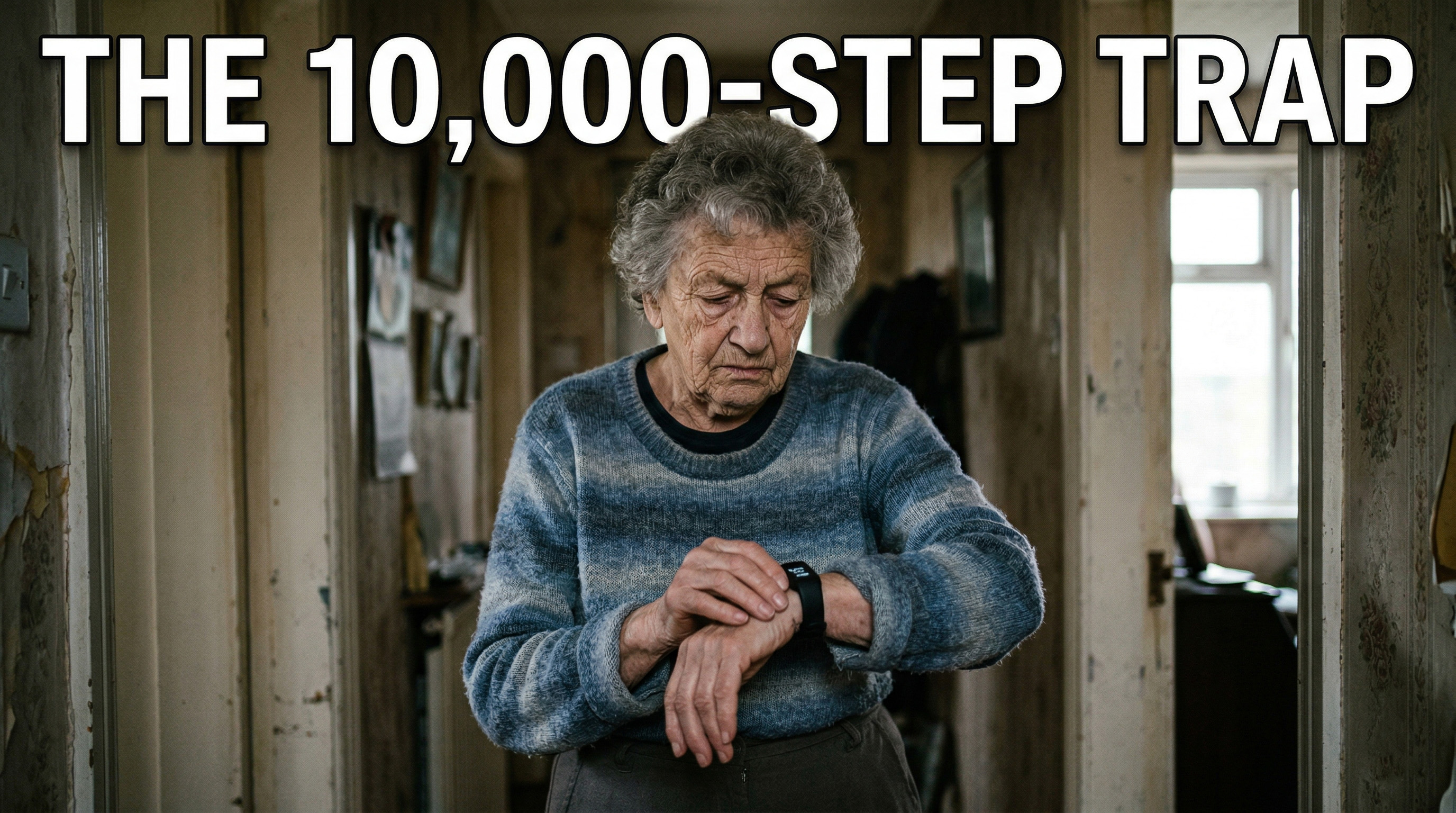
Margaret is 83. Her daughter bought her a fitness tracker last Christmas. It buzzes on her wrist every hour, nudging her to move. So Margaret paces her hallway — back and forth, back and forth — staring at a tiny screen until a cartoon firework tells her she's done well. She hates it. She told her daughter as much. Her daughter said, “But Mom, your steps are up.”
Nobody asked Margaret where she wanted to go.
This is the quiet failure of consumer AgeTech as it has been sold to the aging population for the past decade. The pitch is seductive: strap a sensor on Grandma, watch the data populate a dashboard, and feel reassured. But reassurance for whom? The tracker does not serve Margaret. It serves her daughter’s anxiety. And the steps themselves — disconnected from any place, any person, any errand — are not exercise. They are purgatory with a step count.
Walking is not a workout. It is a way of being in the world. An 85-year-old who walks six blocks to buy a newspaper is doing something profoundly different from an 85-year-old shuffling across a living room to satisfy an algorithm. The first person is navigating a crosswalk, nodding to a neighbor, smelling bread from a bakery vent, choosing between two headlines at the newsstand, and carrying something home that matters to them. They are exercising cognition, spatial awareness, social reciprocity, and autonomy — simultaneously. The second person is performing a medicalized chore, alone, for an audience of software.
Gerontologists have understood this distinction for years. Intrinsic motivation — the internal desire to do something because it has meaning — is one of the strongest predictors of sustained physical activity in older adults. Extrinsic nudges, like buzzing wristbands and step goals borrowed wholesale from corporate wellness programs designed for 35-year-old office workers, may produce short compliance spikes, but they often fade quickly. When you reduce walking to a health metric, you strip away the very thing that makes a person want to walk. You remove the destination.
But this is where the conversation gets harder, and where much of the industry has failed to go.
Getting Margaret to the bakery is not simple. It requires what no wearable can provide: human coordination. Her home aide needs to be scheduled for the right window — not during meal prep, but during the mid-morning hours when Margaret has energy and the sidewalks are dry. Someone needs to check the weather forecast, because a fall on wet pavement is not a data point; it is a hip fracture and a cascade of decline. Her daughter, who lives two states away, needs to know the outing is happening so she is not blindsided by a call. And if Margaret’s physical therapist has flagged that her gait is deteriorating on the left side, the aide accompanying her needs to know to walk on that side.
A step tracker organizes none of this. It just counts.
This is the operational gap Agefully is built to close. Not by adding another sensor, but by giving families, professional caregivers, and the older adult themselves a shared workspace where real life gets coordinated. A shared calendar that does not just show medical appointments, but schedules the Tuesday bakery walk. Task management that ensures the aide confirms weather conditions and the daughter gets a simple update — not a heart-rate graph, but a message: Mom walked to the bakery with Rosa. She picked up rye bread and said hello to the florist.
That is dignity captured in a workflow, not a waveform.
A necessary caveat: when an older adult suddenly cannot walk, loses balance without explanation, or experiences sharp fatigue, these are not scheduling problems. They can signal serious neurological, cardiovascular, or orthopedic conditions that demand clinical evaluation. A coordination platform does not replace a geriatrician’s diagnosis, a prescribed rehabilitation plan, or hands-on physical therapy. Agefully is infrastructure for daily life — not a substitute for medical care.
But daily life is exactly what has been neglected. The industry has invested billions in monitoring aging bodies while investing almost nothing in supporting aging lives. We have dashboards full of biometric data and calendars empty of meaningful activity. We track heart rates but not whether someone made it to their granddaughter’s school play.
It is time to stop treating older adults like patients generating data and start treating them like people with places to be. The question was never “How many steps did she take?” The question is: “Where does she want to go — and who is making sure she gets there?”