Abstract
For decades, public health policies and commercial strategies have treated people over 65 as a homogeneous cohort. This approach, based on chronological age, is now scientifically and economically obsolete. Driven by the extension of healthy life expectancy (healthspan), the longevity market is undergoing a "great fragmentation." Drawing on contemporary gerontological frameworks—notably Rowe and Kahn (1997), Baltes and Baltes (1990), and the frailty phenotype of Fried et al. (2001)—this article proposes an ideal-typical construct of three aging profiles defined not by age, but by functional, cognitive, socio-economic, and technological trajectories: Vitality Seekers, Independence Defenders, and Complex Care Profiles. The article examines how social determinants (gender, class, geography) modulate these trajectories and lays the ethical foundations for AgeTech innovation that respects the agency of aging individuals.
1. The Obsolescence of the “Senior” Category: A Conceptual and Commercial Problem
The Gap Between Administrative Category and Empirical Reality
The World Health Organization, in its World Report on Ageing and Health (WHO, 2015), documented a fundamental observation: the diversity in physical and mental capacities is greater among older people than in any other age group. A 75-year-old may have a level of functional capacity comparable to a 55-year-old, or conversely, manifest severe limitations.
The term "senior," used as a broad market category encompassing four decades of life (from 60 to 100 years old), rests on an implicit assumption: that the transition to retirement triggers a uniformity of needs. Longitudinal data from major cohort studies—such as the Survey of Health, Ageing and Retirement in Europe (SHARE) and the US Health and Retirement Study (HRS)—demonstrate the exact opposite. Aging is a process of increasing differentiation, where inter-individual gaps widen with advancing age (Dannefer, 2003).
From the Deficit Model to Plural Trajectories
Gerontology itself has navigated this epistemological debate. The classic biomedical model conceptualized aging as a linear and inevitable decline. Rowe and Kahn (1987, 1997) introduced a breakthrough by distinguishing between successful aging, usual aging, and pathological aging. Despite critiques regarding its normative nature and bias toward privileged social classes, it paved the way for a pluralistic understanding of aging.
Simultaneously, Baltes and Baltes (1990) proposed the SOC model (Selective Optimization with Compensation), suggesting that aging individuals actively adapt by selecting domains to invest their declining resources, optimizing their residual skills, and compensating for their losses. This model is essential for understanding the technological consumption behaviors of older adults: adopting a tool is not passive; it is part of an individual adaptive strategy.
Faced with this reality, the market is executing an "unbundling" of its offerings. Standardized solutions are gradually giving way to hyper-segmented approaches, dictated by the level of preserved autonomy, attitudes toward health, and the socio-economic resources available to the individual.
2. Taxonomic Proposition: Three Ideal-Typical Profiles of Aging
The following tripartite division is an ideal-typical construct in the Weberian sense. It does not claim to describe airtight empirical categories but provides heuristic tools to understand the heterogeneity of aging. These profiles are defined by functional, cognitive, behavioral, and social criteria—not chronological age. The age ranges mentioned indicate statistical predominance, not normative boundaries.
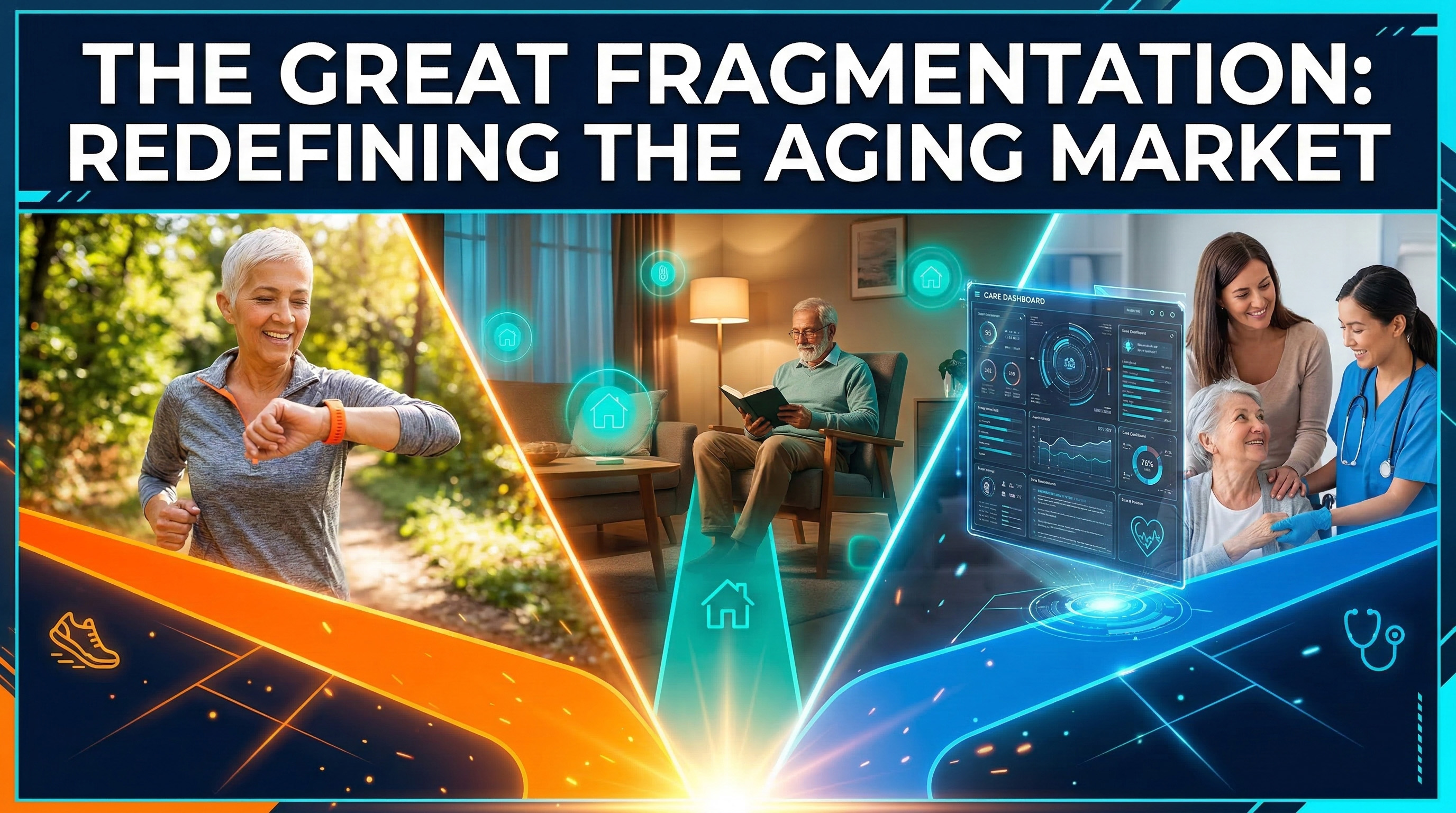
Profile A: The Vitality Seekers (Statistical Predominance: 55–70 years)
Functional Characterization: Absence of significant limitations in Instrumental Activities of Daily Living (IADLs). Preserved intrinsic capacity. The goal is not to treat a disabling pathology but to extend healthspan.
Psychosocial Positioning: According to Carstensen’s socioemotional selectivity theory (1992, 2006), the perception of a still-open time horizon encourages this group to seek new experiences. They reject traditional markers of old age and align with longevity optimization discourses.
Technological Behavior: They are early adopters of wellness technologies: smartwatches, nutritional tracking apps, and preventive diagnostics. Their relationship with technology is proactive and consumerist.
Strategic Imperative: This segment consumes health as a service (Longevity-as-a-Service). Solutions should focus on performance, maintaining muscular and cognitive capital, and active social integration.
Profile B: The Independence Defenders (Statistical Predominance: 70–85 years)
Functional Characterization: Moderate physiological vulnerability corresponding to the pre-frailty or early frailty stage (Fried et al., 2001). Often managing stable chronic conditions. The primary risk is the frailty cascade: a triggering event (a fall, hospitalization, or bereavement) that can precipitate rapid loss of autonomy.
Psychosocial Positioning: The absolute goal is aging in place. AARP (2021) data indicates that 77% of adults over 50 want to remain in their homes as they age.
Technological Behavior: This profile adopts technology only if it solves a concrete, immediate problem without stigmatization or infantilization. Technology must invisibly compensate for frailties: non-intrusive ambient sensors, simplified interfaces, and platforms facilitating social connection.
Strategic Imperative: This is the core segment of current AgeTech innovation. Solutions must combat apathy and social isolation—a leading factor of excess mortality (Holt-Lunstad et al., 2015)—without medicalizing daily life. They must offer structuring routines that preserve a sense of mastery and social utility.
Profile C: Complex Care and Dependency (Statistical Predominance: 85+ years)
Functional Characterization: Significant loss of autonomy in basic Activities of Daily Living (ADLs: bathing, dressing, eating). High prevalence of major neurocognitive disorders (such as Alzheimer's disease).
Psychosocial Positioning and Agency: The primary decision-maker for technology consumption shifts to the family caregiver and the healthcare system. However, it is ethically problematic to assume dependent older adults lose all agency. Dementia studies (Kitwood, 1997; Kontos, 2005) highlight "embodied selfhood"—the retention of preferences and expression of comfort even in severe cognitive decline.
Strategic Imperative: Solutions must aim simultaneously to: (a) alleviate caregiver burden to prevent burnout; (b) secure the environment (fall and wandering detection); and (c) coordinate care among professionals, informal caregivers, and institutions.
3. The Blind Spots: Social Determinants, Gender, and Territory
The functional taxonomy proposed above cannot be understood independently of the social determinants of health.
- Social Inequalities: Healthy life expectancy varies drastically by socioeconomic status. A 62-year-old manual worker may have a functional profile comparable to a 75-year-old executive. Segmentation amplifies social inequalities if not contextualized by material living conditions.
- Gender: Women live longer but in poorer health (the morbidity-mortality paradox). They are overrepresented in Profiles B and C, and constitute the vast majority of informal family caregivers.
- Territory: Spatial disparities in access to healthcare (medical deserts) and digital services (the digital divide) act as additional fragmentation factors, directly impacting the feasibility of aging in place.
4. From Static Profiles to Dynamic Trajectories: The Interoperability Challenge
An individual will inevitably transition from one profile to another. The SOC model (Baltes and Baltes, 1990) suggests this transition is not a passive collapse but an active process of reallocating resources.
Consequently, AgeTech ecosystems must be designed as evolutionary architectures. An interface focused on social engagement (Profile A) must seamlessly evolve into a care coordination interface (Profile B), and eventually into a dashboard for caregivers and medical professionals (Profile C). The same hardware must adapt as the user's capacities transform, ensuring continuity of care without stigmatizing "threshold crossings."
5. Ethical Implications: Segmenting Without Reducing
Behavioral segmentation of aging populations raises inescapable ethical questions:
- Consent and Surveillance: Ambient sensors are surveillance tools. The line between protection and control is thin, especially for Profile C, where the capacity to consent may be impaired.
- Justice of Access: If AgeTech solutions are developed primarily for the most solvent segments, the market risks creating two-tiered innovation: optimization for the wealthy, and neglect for the vulnerable.
- Dignity and Representation: Categorizing individuals risks reducing them to their level of dependency. The capabilities approach (Sen, 1999) reminds us that the goal is not merely maintaining functions, but preserving the real freedom to lead a life one has reason to value.
Conclusion
The myth of a monolithic "Senior" market crumbles when confronted with demographic, epidemiological, and sociological realities. The "Great Fragmentation" demands analytical rigor and ethical sensitivity from health and technology stakeholders.
By aligning solution development with functional trajectories, socio-economic resources, and attitudes toward autonomy rather than chronological age, it becomes possible to design technological environments that respect the dignity and agency of the user at every stage of their longevity. However, this ambition will only be realized if functional segmentation is systematically cross-referenced with an analysis of the underlying social inequalities.