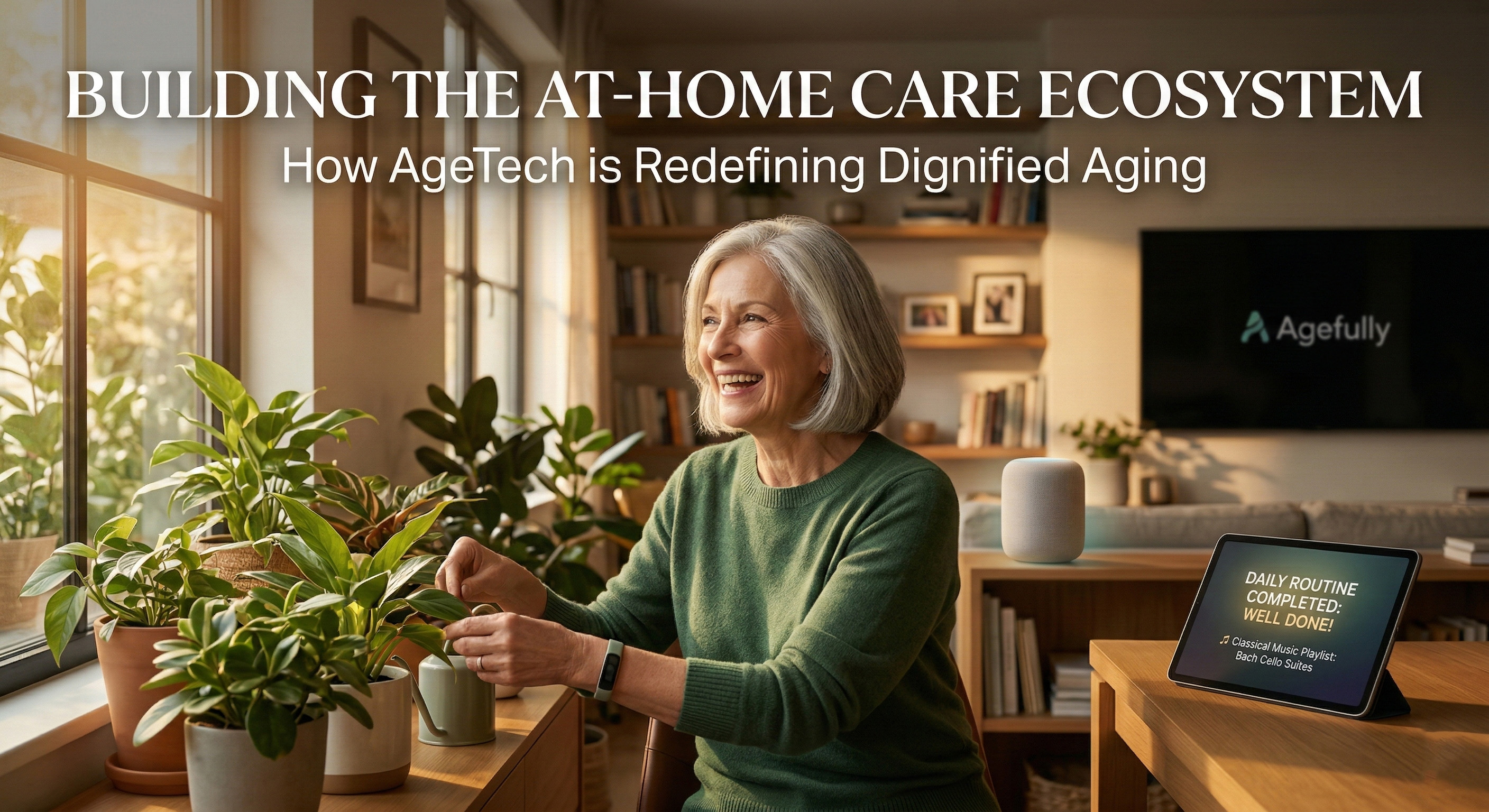
Historically, long-term care facilities (nursing homes) have always provided a fundamentally "bundled" offering: housing, clinical monitoring, meals, security, social activities, and daily coordination. Today, this centralized institutional model is undergoing unprecedented economic and capacity pressures.
In the United States, the 2024 national median cost for a semi-private room in a medicalized facility is approximately $111,325 per year, while a private room reaches $127,750, according to the Genworth Cost of Care survey. On the demand side, federal estimates (ASPE/HHS) indicate that about seven out of ten adults turning 65 will experience an episode requiring long-term services and supports (LTSS). Faced with this structural demand, the financial fragility of the sector is intensifying, with numerous professional surveys reporting that a significant portion of facilities now operates at a loss.
In this context, the market is witnessing an emerging dynamic of "unbundling." This concept refers to the decomposition of institutional functions, formerly sold as a block, into modular services delivered directly to the patient's home. These services are then recomposed via human, digital, or hybrid coordination. However, it is crucial to emphasize that this unbundling does not eliminate the institution; rather, it tends to reserve medicalized housing for clinical situations where continuous presence and a highly secure environment are indispensable.
Clinical Segmentation: What Unbundles and What Resists
“Old age” is not a homogeneous demographic segment. The feasibility of aging in place depends on strict variables: the level of autonomy (Activities of Daily Living or ADLs), cognitive state, the presence of high-risk comorbidities (heart failure, diabetes, fall risk), and the availability of a family caregiver or professional relay.
Consequently, certain services are easily unbundled. This is the case for scheduled nursing care, telehealth, medication dose preparation and delivery, adapted meal delivery, and non-emergency medical transportation (NEMT).
Conversely, a physiological boundary limits this model. Situations requiring 24/7 monitoring with high vital risks resist at-home care. This is particularly true for advanced dementias accompanied by severe behavioral disorders and wandering risks, or complex post-acute care requiring specialized equipment that cannot be replicated at home at an equivalent cost and quality. Furthermore, for certain profiles, physical collective living in an institution plays a therapeutic socialization role that digital interfaces cannot entirely replace.
The At-Home Operational Architecture (The "Stack")
The at-home care ecosystem is structured as a stack of service layers. Its actual performance depends less on pure technological sophistication than on the rigor of its clinical and logistical operations.
1. The Clinical and Coordination Layer
This relies on scheduling physical interventions, sharing interprofessional information, and telehealth. The primary limitation of this layer remains the shortage of the healthcare workforce and its uneven geographic coverage, which naturally hinders its expansion.
2. The Monitoring Layer (RPM)
Remote Patient Monitoring (RPM) operates on a strict logic: data collection (mobility, vital signs), comparison to a baseline, and clinical triage leading to an action (therapeutic adjustment, visit). The major structural risk of this layer is the overload of non-actionable alerts (alarm fatigue). The robustness of a solution is therefore judged by its ability to filter signals: it must explicitly define who processes the alerts, under what clinical protocol, and how it avoids flooding doctors with raw data.
3. The Logistics Layer
This ensures the reliable execution of daily needs: meal deliveries, pharmaceutical refills, and service continuity. The inherent obstacle in this layer lies in the cost of the "last mile," making its viability outside dense urban areas highly dependent on local economies of scale or public subsidies.
4. The Social and Cognitive Layer
Designed to prevent isolation, this layer offers regular interactions and guided exercises via screens. However, its adoption plummets if the ergonomics fail to compensate for the visual or motor deficits of the users. Additionally, the actual effect of these tools on preventing long-term cognitive decline still needs to be consolidated by pragmatic clinical trials.
5. The Data and Orchestration Layer
This is the central nervous system that unifies the care pathway by centralizing alerts and access to reduce the caregiver's burden amid the multiplication of providers. While interoperability is progressing thanks to IT standards (like HL7 FHIR), bi-directional integration with hospital Electronic Health Records remains a costly and complex process in terms of governance and security.
Financing Models: Who Pays and For What Outcome?
The viability of this technological architecture is structured around four distinct economic models, differentiated by the buyer's profile and their required return on investment:
- B2B Orchestration (Care Orchestration): SaaS software is sold to home care agencies. This model is highly technologically scalable, but its growth is pegged to clients (agencies) operating with historically constrained financial margins.
- The Payor-Driven Model: The insurer finances the at-home ecosystem with a specific goal: to reduce avoidable costs that it bears (emergency hospitalizations, complications). This model offers the best economic alignment but imposes long sales cycles and demands irrefutable clinical evidence of cost reduction.
- The Provider-Driven Model: Hospital-at-Home programs enjoy total clinical credibility with patients but often clash with the lack of logistical agility inherent in large hospital structures.
- The Consumer Model (B2C): Paid directly by families, this model allows for rapid deployment but quickly hits a financial glass ceiling in the absence of third-party reimbursement.
Systemic and Regulatory Risks
The large-scale deployment of this unbundling raises profound systemic challenges. The first is the fragmentation of care: without perfect orchestration, the multiplication of micro-providers merely shifts the coordination burden onto the family, exacerbating caregiver burden.
Next arises the issue of medicolegal liability. In the event of a false negative (for example, a sensor failing to detect a severe fall), determining liability within the value chain (device manufacturer, software publisher, triage center, doctor) remains an area of legal friction. Finally, highly technological aging in place raises issues of equitable access and requires rigorous management of continuous consent for cognitively fragile patients.
Conclusion: The Reality Check of the Next Decade
The unbundling of medicalized facilities is not an abstract technological disruption; it is a highly operational recomposition of institutional functions at the patient's home, occurring under severe constraints of workforce, logistics, and data governance.
For the coming decade, the strategic question is no longer whether we can technically measure health remotely. The challenge is determining who finances this model, what clinical evidence is required by payors, and how to transform a multitude of fragmented services into a readable care pathway. The players who will dominate this market will be those capable of demonstrating a complete end-to-end mechanism (from data to clinical action) while integrating interoperability and security by design into their products.
Operational Glossary:
- LTSS: Long-Term Services and Supports.
- RPM: Remote Patient Monitoring.
- Value-based care: A financing model linking provider payment to the quality of clinical outcomes achieved, rather than the volume of services performed.
- EHR: Electronic Health Record.
- FHIR (HL7): An international health data exchange standard facilitating interoperability between computer systems.