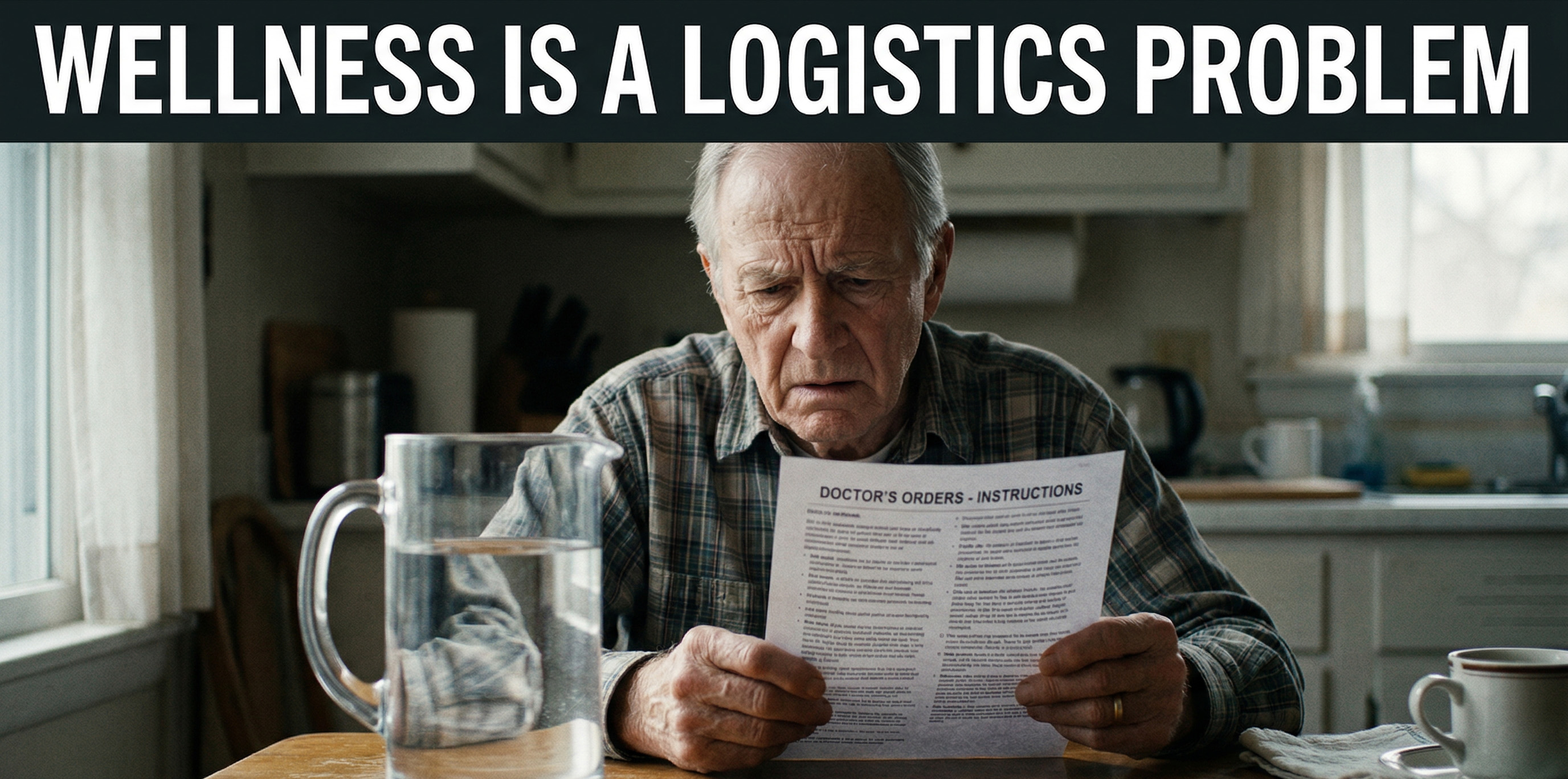
Somewhere right now, an 80 year old is sitting at a kitchen table with a printed sheet of health recommendations from a recent doctor's visit. Drink eight glasses of water. Get 15 minutes of morning sunlight. Eat 25 grams of protein at breakfast. The advice is clinically sound. It is also, in practical terms, almost entirely useless.
Not because the person does not understand it. Not because they lack motivation. But because advice without infrastructure is just words on paper. We have built an entire wellness culture around the assumption that knowledge leads to action, that if people simply know what to do, they will do it. For an aging adult living alone or with limited support, this assumption collapses under the weight of daily reality.
Willpower is a finite resource at any age. At 80, it competes with joint pain, fatigue, medication side effects, and the slow erosion of routines that once felt automatic. The real question is never “Does this person know what is good for them?” It is: “Who is making sure the conditions exist for them to actually do it?”
Deconstructing the Day
Take those three recommendations and look at what they actually demand.
Hydration. The instruction is simple: drink more water. But consider the chain of actions involved. Someone must fill a pitcher. It must be placed within arm's reach, on the correct side, accounting for dominant hand use or limited mobility. The glass must be lightweight and easy to grip. Failing to drink water is rarely about forgetting that water matters. It is about the absence of a system that removes friction from the act of drinking.
Morning sunlight. Fifteen minutes of outdoor light before 10 a.m. can improve sleep, mood, and circadian rhythm. But getting outside requires shoes that are easy to put on, a walkway free of tripping hazards, appropriate clothing laid out the night before, and ideally, someone who knows this walk is happening in case of a fall. One missing link in that chain, and the recommendation dies quietly in the living room.
Protein intake. Eating enough protein at breakfast means someone needs to shop for the right food, store it accessibly, prepare it safely, considering stove use, knife handling, and standing tolerance, and serve it at a time that does not conflict with morning medications requiring an empty stomach. This is not a nutrition problem. It is a supply chain problem.
The Myth of Solo Wellness
We often confuse independence with isolation. True independence for an aging adult does not mean doing every task alone. It means having an ecosystem around you that handles the logistics so your limited energy goes toward the things that actually make life worth living: a conversation with a grandchild, a slow walk through the garden, reading in a favorite chair.
The goal is not self sufficiency at all costs. The goal is a coordinated environment where the right support arrives at the right moment, so the person at the center of it all can focus on living rather than surviving.
The Agefully Orchestration
This is the problem Agefully was built to solve. The platform operates as a shared coordination layer connecting the aging adult, their family, and their professional care team into one unified system.
In practice, it works like this. A physical therapist recommends a daily morning walk. That recommendation becomes visible to the entire care circle. The family schedules a home aide to arrive at 8:30 a.m. The aide's checklist includes laying out walking shoes, filling the water bottle, and confirming breakfast, with adequate protein, is prepared before they head outside together. After the walk, the aide logs completion. The family sees it. The therapist sees it. No one is guessing. No one is duplicating effort. Everyone operates from the same playbook.
This is not surveillance. It is orchestration. The difference matters enormously.
A necessary clinical note: chronic dehydration, sudden lethargy, or severe dietary aversions can indicate serious underlying conditions, including kidney dysfunction, depression, or medication interactions. Agefully is a coordination platform, not a clinical tool. It does not replace a medical evaluation by a licensed physician. When concerning patterns emerge, the appropriate response is always a professional clinical assessment.
A Healthy Day Is Built, Not Wished For
A good day at 80 is not a matter of luck or personal discipline. It is a matter of design. The water within reach, the shoes by the door, the aide who arrives on time, the family who can see that everything is on track: these are not luxuries. They are infrastructure.
A healthy day is never wished for. It is built.