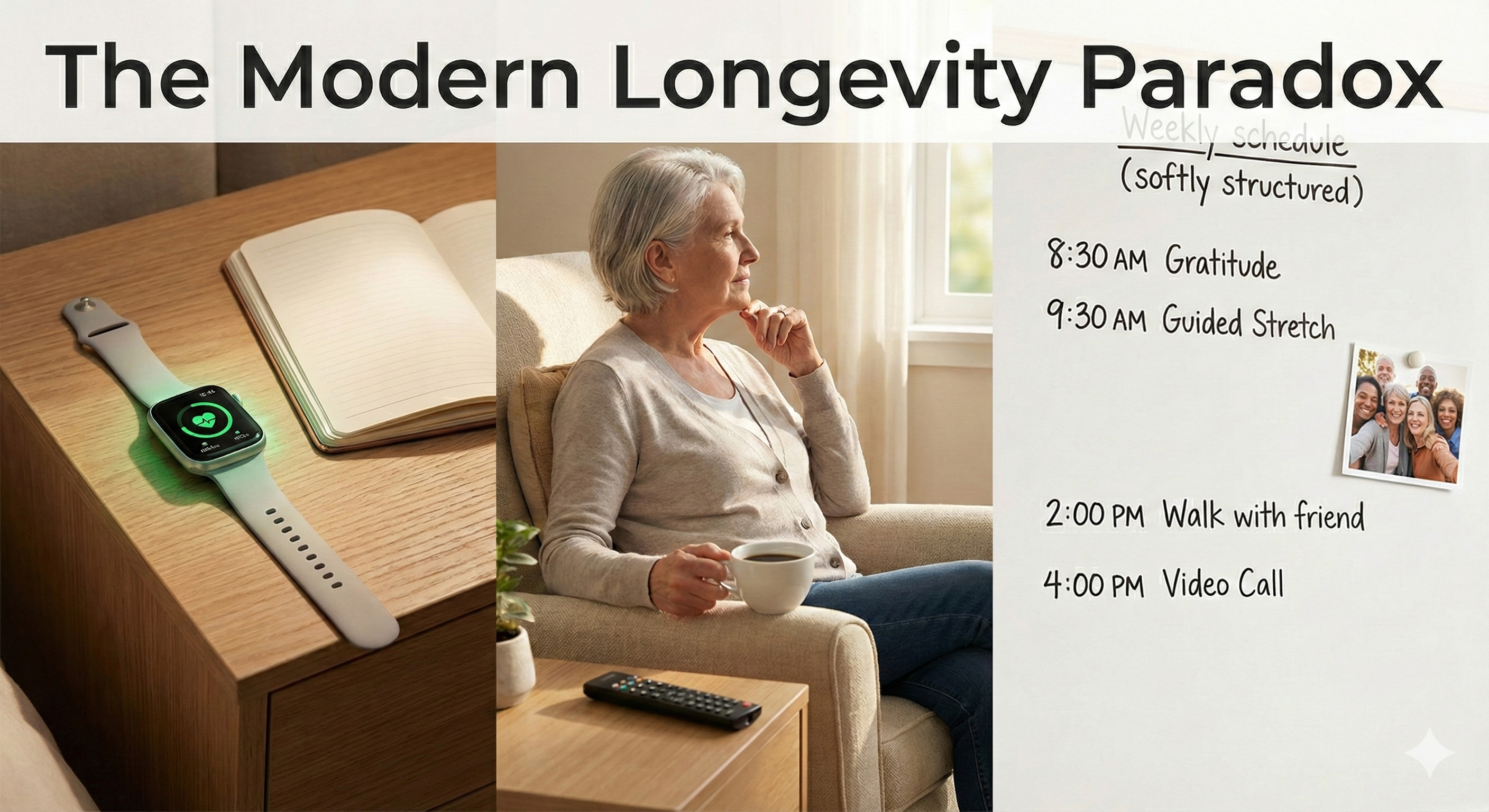
Longevity: Why Tracking Your Health Is No Longer Enough — And What Science Suggests Instead
The Modern Paradox: More Data, No More Action
In 2025, there are over 560 million active users of smartwatches and fitness trackers worldwide (Statista, 2025). These devices count our steps, analyze our sleep cycles, and measure our heart rates with clinical precision. Never before has humanity had access to so much information about its own biology.
And yet, the results aren't following. The World Health Organization estimates that physical inactivity remains responsible for nearly 3.2 million deaths globally each year (Global Status Report on Physical Activity, updated 2024). Among older adults, the reality is even starker: according to data from the National Health Interview Survey (CDC, 2024), only 15.5% of adults aged 65 and older meet all public health recommendations for physical activity.
The problem, therefore, is not a lack of information. It lies elsewhere.
Decision Fatigue: An Invisible but Documented Obstacle
In the late 1990s, psychologist Roy Baumeister formalized the concept of decision fatigue (or ego depletion)—the idea that our capacity to make good choices erodes throughout the day as decisions accumulate. While this model has been debated in recent literature regarding its exact neurological mechanisms (Vohs et al., 2021), it remains a widely used explanatory framework in applied psychology and gerontology to understand the difficulty of daily self-initiation.
Applied to aging, this phenomenon takes on a specific dimension. When a retired person wakes up without an imposed structure—no more work schedules, and sometimes fewer regular social contacts—they face what could be called the morning decision void: What am I going to do today? With whom? Why?
These three questions represent a real cognitive load. And when mental energy is lacking, the default answer often becomes: nothing. This is not laziness. It is unresolved cognitive friction.
A Concrete Example
Margaret (a composite fictional case built from testimonies documented in gerontological literature), a 72-year-old retired teacher, perfectly illustrates this mechanism. After retiring, she described her mornings like this:
"I had plenty of projects in mind, but every morning, I found myself sitting with my coffee, not knowing where to start. So I would watch television. Not because I wanted to, but by default. After six months, I hardly saw anyone anymore."
Her case is not exceptional. A study published in The Journals of Gerontology (Infurna et al., 2020) demonstrated that the transition to retirement is accompanied by a drastic decline in psychological well-being for nearly 30% of individuals, directly linked to the loss of daily structure.
What the Science of Longevity Actually Teaches Us
Longevity is often attributed to the genetic lottery. However, large-scale studies estimate that genetics explain only about 20% to 25% of the variation in human lifespan (Herskind et al., 1996). The rest depends on behavioral, environmental, and social factors.
Research on the "Blue Zones" (Okinawa, Sardinia, etc.) confirms this observation. Although some demographic data from these zones have recently been questioned regarding record-keeping errors (Newman, 2019), the life principles observed there remain largely corroborated by independent clinical studies. The inhabitants share common pillars that are not medical, but rooted in a collective framework: natural movement, a sense of purpose (ikigai), and constant integration into a community.
Social Isolation: The Risk Factor We Don't Talk About Enough
In 2023, the U.S. Surgeon General released an official advisory declaring social isolation and loneliness a public health epidemic. The numbers, supported by Julianne Holt-Lunstad’s meta-analyses (2015), are staggering: social isolation increases the risk of mortality by 29%. This places loneliness at a risk level equivalent to smoking 15 cigarettes a day, and higher than obesity.
Social connection is therefore not just a pleasant "bonus." It is a vital health metric. Biologically, chronic isolation durably elevates cortisol, causing chronic low-grade inflammation (inflammaging) which is now identified as one of the biological drivers of accelerated aging.
"Soft Structuring": An Evidence-Based Response
Faced with these findings, an approach is emerging at the intersection of behavioral psychology and gerontology: the soft structuring of daily life. It is not about imposing a rigid schedule, but offering a flexible framework—a suggested starting point that the person is free to accept or adjust. The concept relies on:
- Implementation Intentions (Gollwitzer, 1999): Having a suggested activity at a specific time ("At 9:00 AM, a stretching exercise") doubles the average rate of taking action compared to the vague intention of "exercising during the day."
- The Default Effect: In behavioral economics (Thaler & Sunstein, 2008), it is proven that individuals overwhelmingly keep the default option. Designing days where the default option is engagement eliminates the effort of initiation.
What This Looks Like in Practice
Inspired by active aging programs and behavioral therapies, here is what a "soft pre-structured" day looks like:
| Time | Default Suggestion | Targeted Pillar | Flexibility |
|---|---|---|---|
| 8:30 AM | Three phrases of gratitude | Emotional well-being | Can be done in bed or skipped |
| 9:30 AM | Guided stretching (10 min) | Physical mobility | Adaptable to daily energy levels |
| 10:30 AM | Thematic memory game | Cognitive stimulation | Choice between multiple levels |
| 2:00 PM | Walk or outing (20 min) | Physical activity | Can be shortened to a porch step-out |
| 4:00 PM | Shared group moment | Social connection | Call, voice message, or video chat |
The point is not that every box must be checked, but that the person never has to start from scratch. The cognitive burden shifts from "What will I invent today?" to "I will participate or adjust."
Necessary Nuances: What This Approach Does Not Solve
It would be intellectually dishonest to present soft structuring as a universal cure.
- Advanced Cognitive Decline: For major neurocognitive disorders, the ability to interact with a structured suggestion may be impaired. In-person human support remains irreplaceable.
- Socioeconomic Disparities: Data from the U.S. Census Bureau indicates that millions of older adults live in poverty or economic insecurity. Geographic isolation and financial precarity are barriers that a purely behavioral approach cannot erase.
- Technology is Only a Bridge: Digital tools must facilitate the structuring of daily life and catalyze social connection, never entirely replace it.
Conclusion: Longevity as a Daily Practice
Science is now converging on one clear truth: living a long and healthy life is not solely a matter of medicine or wearable sensors. It is a matter of structure, connection, and purpose.
The data is there. The mechanisms are understood. What is most often lacking is neither information nor the willpower to do well. It is a compassionate framework that makes action easier than inaction. This framework does not require superhuman effort; it requires understanding that we are social beings who need a gentle reason to get up every morning—and a community to share it with.
Sources and References
- Baumeister, R.F., et al. (1998). Ego depletion: Is the active self a limited resource? Journal of Personality and Social Psychology, 74(5), 1252–1265.
- CDC (Centers for Disease Control and Prevention). (2024). National Health Interview Survey.
- Gollwitzer, P.M. (1999). Implementation intentions: Strong effects of simple plans. American Psychologist, 54(7), 493-503.
- Herskind, A.M., et al. (1996). The heritability of human longevity: A population-based study of 2872 Danish twin pairs born 1870–1900. Human Genetics, 97(3), 319-323.
- Holt-Lunstad, J., et al. (2015). Loneliness and Social Isolation as Risk Factors for Mortality: A Meta-Analytic Review. Perspectives on Psychological Science, 10(2), 227-237.
- Infurna, F.J., et al. (2020). Retirement and Well-being: A Review of the Literature. The Journals of Gerontology: Series B, 75(3), 443-453.
- Newman, S.J. (2019). Supercentenarian and remarkable age records exhibit patterns indicative of clerical errors and pension fraud. bioRxiv.
- Statista. (2025). Smartwatches & Fitness Trackers - Worldwide Market Data.
- Thaler, R.H., & Sunstein, C.R. (2008). Nudge: Improving Decisions About Health, Wealth, and Happiness. Yale University Press.
- U.S. Census Bureau. (2024). Income and Poverty in the United States.
- U.S. Surgeon General. (2023). Our Epidemic of Loneliness and Isolation. Advisory on the Healing Effects of Social Connection and Community.
- Vohs, K.D., et al. (2021). A Multisite Preregistered Paradigmatic Test of the Ego-Depletion Effect. Psychological Science, 32(10), 1566-1581.
- World Health Organization (WHO). (2024). Global status report on physical activity.