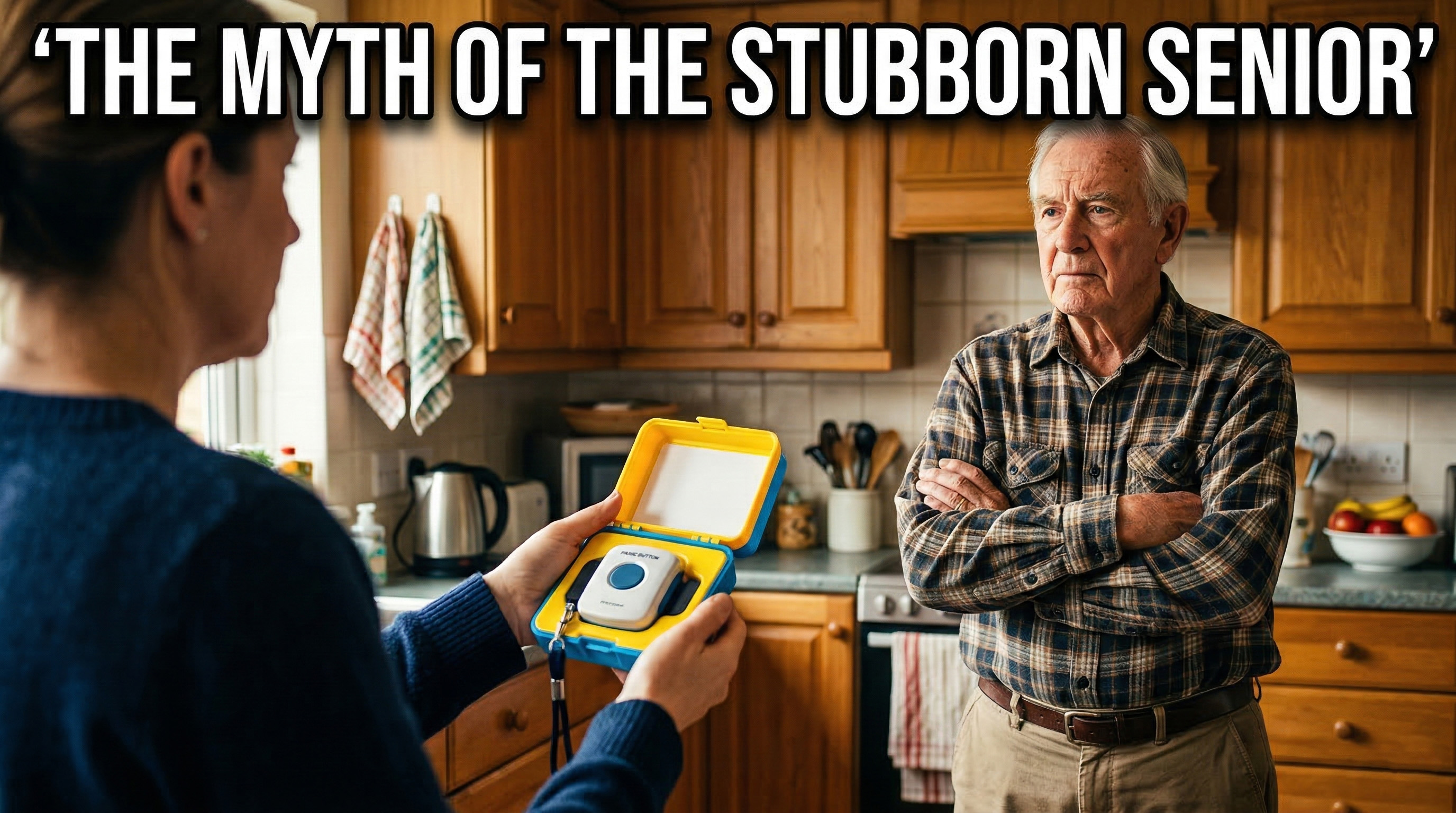
It usually starts over something small. A bracelet. A button. A plastic disc meant to hang around the neck on a lanyard.
Linda brought it over on a Sunday, still in the packaging, along with a container of soup and some bananas. Her father, Ray, eighty-one, recently widowed, living alone in the same split-level he'd owned for forty years, took one look at it and set it on the counter without opening the box. "I don't need that," he said. Linda explained how it worked — one press and help arrives. Ray changed the subject. She brought it up again the following weekend. This time, he was less polite. "I said no." By the third visit, Linda was telling her brother on the phone that their father was being impossible. Stubborn. In denial about his limitations.
That word — stubborn — gets used constantly in these conversations. It circulates among siblings, shows up in caregiver forums, gets whispered in doctors' waiting rooms. Mom won't accept help. Dad refuses to use the app. She won't let anyone into the house. He pulled the monitoring camera out of the wall.
The assumption underneath is that the older person is being irrational. That they don't understand the risk. That they're clinging to pride at the expense of safety. But what if something more precise is going on?
A necessary clarification before going further: this article is about older adults whose cognitive faculties are intact. When dementia or significant cognitive impairment is present, the calculus changes fundamentally — the capacity to assess one's own risk may itself be compromised, and families face a different set of ethical questions entirely. But for the millions of cognitively healthy older people who resist care technology, the explanation is rarely confusion. It is something the people around them tend to misread.
When Help Feels Like Surrender
Aging involves a long series of subtractions. Some are physical — balance, hearing, the ability to drive at night. Some are social — friends die, neighborhoods change, relevance at work disappears. And some are intimate and hard to name: the quiet erosion of being treated as a full participant in your own life.
For many older adults, the remaining territory of selfhood — their routines, their space, their right to decide what happens in their own kitchen — becomes fiercely important. Not because they're being difficult, but because those things are what's left. Control over whether to accept a home aide or wear a device around the wrist isn't a minor logistical question. It can feel existential.
When an adult child presents a safety tool, they see love and concern. When the parent looks at that same object, they may see something different: proof that the people around them now see a patient where a person used to be. The bracelet isn't just a bracelet. It's a reclassification. And some people would rather risk a fall than accept that reclassification without a fight.
This doesn't mean every refusal is wise or that the explanation is always symbolic. Sometimes a device is simply confusing, uncomfortable, or unreliable — practical objections that have nothing to do with dignity. Sometimes resistance reflects depression, withdrawal, or personality patterns that long predate aging. And sometimes, honestly, the family is right to be afraid. The freedom to refuse a fall alarm is also the freedom to lie on a floor for twelve hours. That tension is real and this article does not pretend to dissolve it.
But dismissing all resistance as stubbornness closes the door on understanding what, in many cases, is actually happening. The refusal is often a form of psychological self-defense — a way of saying, I am still here. I still get to decide.
What a Panic Button Really Says
Here's where the technology itself becomes part of the problem.
The AgeTech industry has evolved considerably. Smartwatches with fall detection carry no stigma. Ambient sensor systems can monitor movement patterns without cameras. The crudest products — oversized panic buttons in primary colors, plastic pendants that announce frailty to any visitor — are no longer the only options.
But the philosophical problem runs deeper than industrial design. Even well-designed tools can fail if the underlying relationship between the technology and the person remains extractive rather than collaborative. An elegant app that lets your daughter track your location is still a tracking app. A sensor system that feeds data to a family dashboard the older person never sees still treats them as a data source rather than a participant.
Research on technology adoption among older adults consistently shows that perceived usefulness and perceived control are among the strongest predictors of acceptance. People adopt tools that feel like they serve their purposes, not someone else's. And people can sense — even when they can't articulate it — when a product has been designed about them rather than for them. That instinct isn't stubbornness. It's dignity doing its job.
Backup, Not a Leash
So what would something better look like?
It would start with a different design question. Instead of asking, "How do we keep this person safe?" — which centers the family's fear — the question would be, "How do we support this person's life without making them feel watched, managed, or reduced?"
This distinction matters, but it also demands honesty: all support involves some degree of observation, and any observation can shade into surveillance depending on trust, transparency, and power. The line between backup and monitoring is not a design feature. It's a relationship. Technology can make that relationship easier to sustain or harder, but it cannot replace it.
The most promising approach in care technology draws on what ethicists call relational autonomy — the idea that genuine self-determination doesn't mean being left entirely alone. It means being supported within relationships that respect your agency. Autonomy is not the absence of help. It's the presence of help that doesn't require you to become someone else's project.
This is the philosophy behind platforms like Agefully, which was designed so that the older adult is not a passive object of monitoring but an active participant in a shared support structure. Concretely, that means the older person has visibility into their own care coordination — they are not excluded from the information flow between family and professionals. It means that safety mechanisms are collaborative rather than imposed, and that the system is built around the person's daily life rather than around the family's anxiety dashboard. The design intent is infrastructure, not surveillance: something closer to a shared foundation than a digital leash.
And it requires acknowledging something uncomfortable: the adult child's fear is not pathological either. Linda is not wrong to worry about her father. She is not controlling. She is terrified. The challenge is not to invalidate her concern but to find a form of support that doesn't force Ray to choose between safety and selfhood.
A Better Question
The next time you find yourself frustrated — standing in your mother's kitchen with a device she won't use, or sitting on a call with siblings trying to figure out why Dad won't cooperate — try pausing before you reach for the word stubborn.
Ask instead: What is this person protecting? What does this refusal actually mean? And what kind of support could I offer that wouldn't require them to give up the thing they're holding onto?
There may not be a clean answer. In many families, there won't be. The tension between autonomy and safety does not resolve neatly, and anyone who tells you otherwise is selling something. But the question itself changes the conversation. It moves the family from managing a problem to understanding a person.
Because the resistance you're encountering might not be a wall. It might be a message. And the message, if you're willing to hear it, is simple: Don't take me out of my own story.
The best care technology — the kind worth building, and the kind worth trusting — never does.