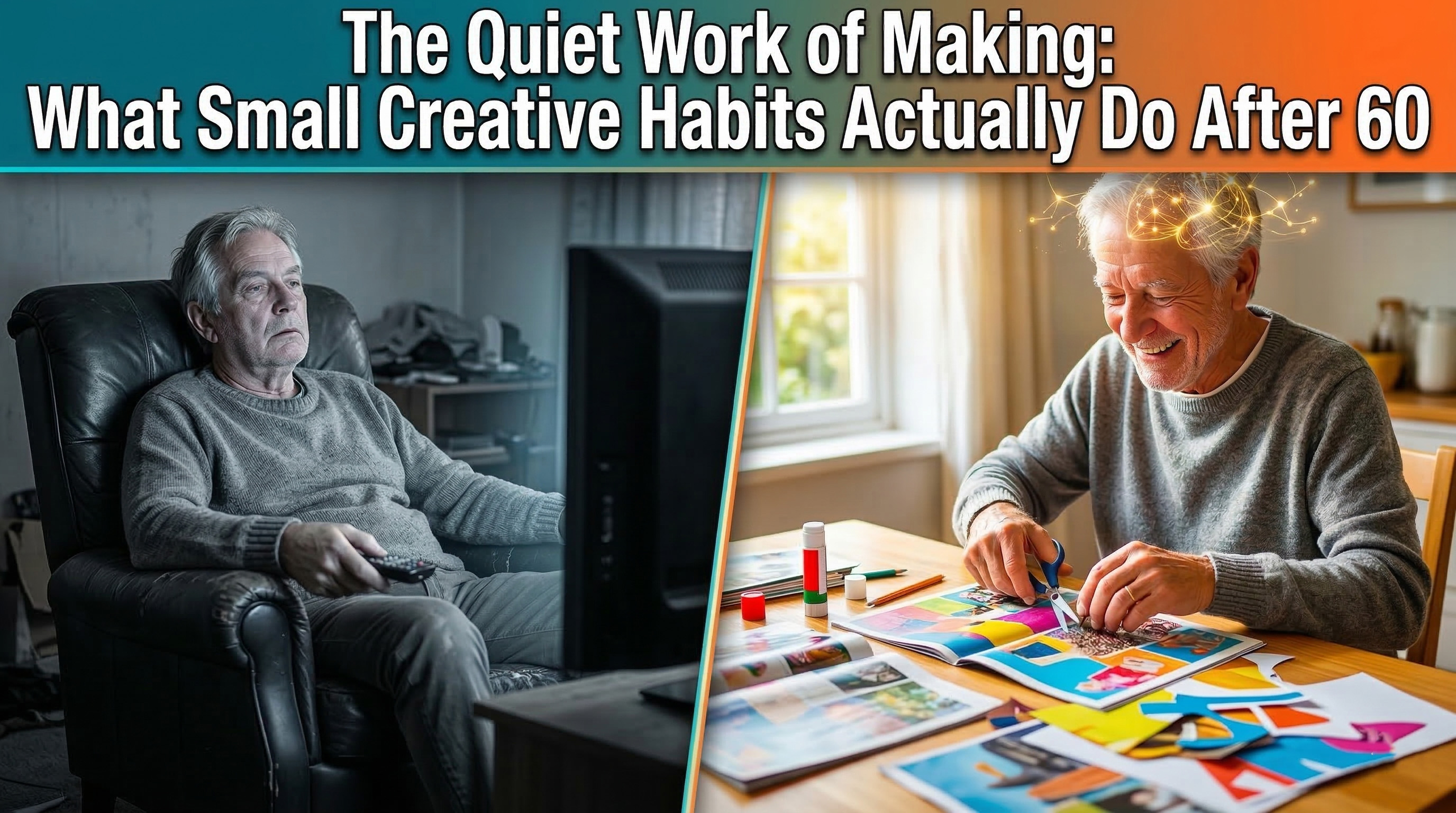
The Quiet Work of Making: What Small Creative Habits Actually Do After 60
Creativity after 60 gets talked about in two ways, both wrong. The first is the miracle narrative: art prevents Alzheimer's, a watercolor class is basically medicine. The second is the patronizing version: how lovely that she's found a little hobby. Both miss the point.
The research tells a more grounded story. A small, regular creative habit—sketching a mug, cutting images for a collage, writing three sentences about a memory—is not a cure for anything. But it does something that surprisingly few other daily activities can match: it asks the brain to generate, choose, and evaluate, in a loop that is both cognitively demanding and emotionally satisfying. For people whose daily routines have lost structure after retirement, loss, or reduced mobility, that loop becomes quietly essential.
This article is about what actually happens—biologically, psychologically, practically—when an older adult makes something small on a regular basis. It draws on peer-reviewed research, not wishful thinking. And it takes seriously the barriers that most advice ignores.
1. The Difference Between Making and Receiving
Not all engagement is equal. Watching a documentary about painting and painting are not doing the same thing to your brain.
In 2014, a neuroimaging study by Bolwerk and colleagues at the University of Erlangen-Nuremberg divided retired adults into two groups: one produced visual art, the other took an art-appreciation course analyzing masterworks. After ten weeks, fMRI scans revealed that the art producers—not the evaluators—showed significantly increased functional connectivity in brain regions associated with cognitive resilience, particularly within the default mode network (Bolwerk et al., 2014, PLOS ONE). Both groups had enjoyed the experience. Only the act of making changed the brain's wiring.
Why? Because producing something—even something simple—requires a chain of micro-decisions. Which color? Where does this shape go? Is this the right word? Each decision creates a feedback loop: intention → action → evaluation → adjustment. That loop recruits the prefrontal cortex, the seat of executive function, in a way that passive consumption does not (Dietrich, 2004, Psychonomic Bulletin & Review).
This is not a moral judgment about television. It is a functional observation: after 60, when work and social roles provide fewer cognitive demands, deliberate making is one of the most accessible ways to keep the prefrontal cortex in active use.
2. Four Mechanisms: What the Science Actually Shows
The benefits of regular creative activity cluster around four mechanisms. None of them require talent.
Attention. Most creative tasks demand sustained focus: drawing an object means looking at it for minutes without interruption; writing a paragraph means holding a thought long enough to finish it. This is attentional training in disguise. It does not "prevent" cognitive decline in the clinical sense, but it maintains the practice of concentration in daily life—something that passive screen time actively erodes.
Memory—especially autobiographical memory. When creative work draws on personal history—a collage about a childhood kitchen, a paragraph about a first job—it asks a person to retrieve a memory, give it form, and place it outside the mind. This process of externalization makes memories more coherent and accessible (Conway & Pleydell-Pearce, 2000, Psychological Review). For older adults navigating identity changes, this is not nostalgia. It is maintenance of narrative continuity: the ability to tell yourself who you are.
Mood. This is the best-documented benefit. Kaimal, Ray, and Muniz (2016, Art Therapy) measured cortisol levels in adults before and after 45 minutes of art-making using markers, paper, clay, and collage materials. They found a significant reduction regardless of the participant's prior artistic experience. The effect was not about being good at art. It was about being absorbed in a self-directed task, which interrupts the recursive, self-referential thinking that fuels anxiety and low mood.
Identity and agency. Erik Erikson (1982) described the central psychological task of later life as ego integrity—the ability to look at one's life as a coherent whole rather than a series of regrets. A creative habit feeds this directly. It produces tangible evidence that a person can still initiate, choose, and complete something. In a phase of life where many things are done to you—medical appointments, bureaucratic forms, well-meaning help—making something is a small, repeatable act of sovereignty.
3. Why Thirty Minutes, and Why Regularity Beats Ambition
There is no clinically validated "dose" of creativity. But there are solid reasons why 30 minutes, repeated regularly, works better than occasional long sessions.
The spacing effect—one of the most robust findings in learning science—shows that distributed practice produces stronger memory consolidation and skill retention than massed practice (Cepeda et al., 2006, Psychological Bulletin). Applied here: four 30-minute sessions across a week build more durable neural pathways than one two-hour weekend marathon.
From a habit-formation standpoint, consistency matters more than duration. Graybiel's work on the basal ganglia (2008, Annual Review of Neuroscience) shows that repeated behaviors gradually shift from effortful, prefrontal-cortex-driven actions to automatic routines. Translation: do it often enough, and starting becomes effortless. The sketchbook opens itself.
For older adults specifically, shorter sessions respect fluctuating energy. Fatigue, pain, medication effects—these are not exceptions; they are the baseline. A habit that demands two hours will collapse within weeks. A habit that asks for 30 minutes—or even 15—survives.
And the routine itself carries psychological weight. Cohen's landmark Creativity and Aging Study (2006, The Gerontologist) tracked older adults in regular arts programs over two years and found that participants reported better overall health, fewer doctor visits, and significantly higher morale compared to controls. The regularity was the intervention.
4. Choosing a Medium: Honest Advice
The best creative medium after 60 is the one you will actually use on a Tuesday afternoon when you are slightly tired and not feeling inspired. That is the real test.
Drawing. A pencil and a cheap sketchbook. Not "learning to draw"—just looking at one object and putting marks on paper for 20 minutes. A mug, a shoe, a hand. The point is observation: the discipline of seeing what is actually there rather than what you think is there. This is harder and more absorbing than it sounds.
Collage. Scissors, glue, old magazines. Collage sidesteps the "I can't draw" barrier entirely. The creative decisions—this image, not that one; here, not there—are acts of selection and composition. A prompt helps: "things that feel like home," "blue," "what I would keep if I had to choose."
Photography. A phone camera is enough. One useful constraint: photograph five things in your immediate environment that you normally ignore. A crack in the wall, the light on a glass, the texture of a sleeve. Photography-as-habit is really a practice of deliberate noticing.
Writing. Ten minutes, longhand, about one sensory memory. The kitchen in the first apartment. What did it smell like? What was on the counter? No grammar rules. One useful move afterward: underline one sentence that surprised you. That sentence is the real material.
Adaptation is normal, not an accommodation. Low vision: thick black markers on white paper, high-contrast collage, voice-recorded storytelling. Tremor or arthritis: larger tools, padded grips, mediums that demand less fine-motor precision. Fatigue: two 15-minute sessions instead of one 30-minute block. The mechanism—making small decisions, sustaining focus, producing something tangible—remains intact regardless of the tool.
5. What Actually Gets in the Way
The usual advice says "just start." The reasons people don't start—or don't continue—deserve more honesty.
"I'm not creative." This is the most common barrier, and it is an identity claim, not a fact. It usually traces back to a specific moment: a teacher's comment, a comparison with a sibling, a humiliation in art class at age 12. That moment calcified into a belief. The belief is wrong—creativity is a cognitive capacity, not a personality trait—but it feels true, which is what matters. Naming the origin can sometimes loosen its grip.
"It has to be good." Product orientation kills creative habits faster than anything else. If the drawing has to be "good," then every session becomes a test, and tests are stressful, and stressful things get avoided. The reframe is not "it doesn't matter" (which feels dismissive) but rather: the function of this activity is the doing, not the result. The sketch goes in the drawer. The collage goes on the fridge for a week and then into recycling. The product is compost. The process is the point.
Invisible practical friction. Supplies in a closet. A table that needs clearing. A phone camera buried three swipes deep. Every small obstacle between the impulse and the action is a potential exit point. The most effective intervention is absurdly simple: leave the materials out. Sketchbook open on the table. Scissors and glue in a tray by the chair. Camera app on the home screen. Reduce the startup cost to near zero.
Energy and pain. Some days, 30 minutes is too much. The habit needs a minimum viable version: five minutes looking at yesterday's sketch, one photograph, three sentences. The goal on a bad day is not to produce something; it is to not break the chain.
6. The Social Layer: Connection Without Performance
Creative habits are often framed as solitary, but their social dimension matters—when handled carefully.
The key distinction is between witness and evaluation. Sending a photo of a sketch to a daughter—not for feedback, just as a quiet signal of "this is what I did today"—is witness. It creates connection without judgment. Posting work for public feedback, entering competitions, or receiving unsolicited advice ("You should sell these!") introduces evaluation, which transforms the habit into a performance and usually kills it.
Cohen's Creativity and Aging Study (2006) found that the social component of arts engagement—simply being with others who were also making things—was a significant contributor to the health and morale benefits observed. The mechanism was not critique or instruction. It was shared presence during a generative activity.
For family members and caregivers, a shared creative activity—making a collage together during a visit, looking at photos side by side—can restructure a relationship that has become defined by care tasks. It creates a space where the older person is not a patient but a collaborator. This is not a small thing.
7. What This Is and What This Isn't
Honesty matters here. A creative habit is not a treatment for dementia, depression, or chronic illness. It is not a substitute for medical care, therapy, or social services. The research is suggestive and encouraging, but much of it relies on small samples, self-reported outcomes, and short follow-up periods. The large-scale, long-term randomized controlled trials that would establish causation mostly do not exist yet.
What the evidence does support, consistently, is that regular creative engagement is associated with better mood, maintained cognitive activity, stronger sense of identity, and greater social connection in later life. These are not small things. They are the substrate of daily well-being.
The strongest claim this article makes is modest: making something small, on a regular basis, with low pressure and adequate support, is one of the most accessible ways for an older adult to stay in active contact with their own mind, their own history, and the people around them.
That is enough. It does not need to be more.
A Non-Prescriptive Starting Point
Pick one medium. Not the one you think you should do—the one that sounds least intimidating.
Gather materials and leave them visible.
Aim for four sessions in the first week. Fifteen to thirty minutes each. Set a timer so you don't have to decide when to stop.
After two weeks, share one piece with one person. A text, a photo, a sentence read aloud. No request for feedback.
After a month, notice whether the habit has changed anything about your day. Not whether the work is good—whether the day feels different.
References
- Bolwerk, A., Mack-Andrick, J., Lang, F.R., Dörfler, A., & Maihöfner, C. (2014). How art changes your brain: Differential effects of visual art production and cognitive art evaluation on functional brain connectivity. PLOS ONE, 9(7), e101035.
- Cepeda, N.J., Pashler, H., Vul, E., Wixted, J.T., & Rohrer, D. (2006). Distributed practice in verbal recall tasks: A review and quantitative synthesis. Psychological Bulletin, 132(3), 354–380.
- Cohen, G.D., Perlstein, S., Chapline, J., Kelly, J., Firth, K.M., & Simmens, S. (2006). The impact of professionally conducted cultural programs on the physical health, mental health, and social functioning of older adults. The Gerontologist, 46(6), 726–734.
- Conway, M.A., & Pleydell-Pearce, C.W. (2000). The construction of autobiographical memories in the self-memory system. Psychological Review, 107(2), 261–288.
- Dietrich, A. (2004). The cognitive neuroscience of creativity. Psychonomic Bulletin & Review, 11(6), 1011–1026.
- Erikson, E.H. (1982). The Life Cycle Completed. W.W. Norton.
- Graybiel, A.M. (2008). Habits, rituals, and the evaluative brain. Annual Review of Neuroscience, 31, 359–387.
- Kaimal, G., Ray, K., & Muniz, J. (2016). Reduction of cortisol levels and participants' responses following art making. Art Therapy, 33(2), 74–80.