Open any kitchen junk drawer in a household where an aging parent lives—or used to live—and you will find the graveyard. A fall-detection pendant still sitting in its charger. A simplified tablet, powered off for months. A smart pill dispenser that beeped so aggressively its owner unplugged it and went back to a sandwich bag. Somewhere in a closet, there is probably a Wi-Fi camera a well-meaning son installed over the living room, later covered with a dish towel because his mother said it made her feel watched rather than supported.
For the better part of a decade, the “Silver Economy” poured money into devices for older adults. The thesis was elegant, investor-friendly, and ultimately too narrow: aging populations represented a large consumer market, so the answer was to build dedicated hardware for seniors—simpler interfaces, larger buttons, friendlier industrial design, softer language around independence and safety. Some products helped. Many did not last. Again and again, the same pattern emerged: a product was purchased out of concern, introduced with optimism, then quietly abandoned when it failed to fit the rhythms, preferences, dignity, or actual problems of daily life.
The issue was never just engineering. It was a mistaken theory of the customer.
The Invisible Workforce Behind the System
The real customer was rarely the 80-year-old living with frailty. More often, it was the 50-year-old standing behind her.
According to AARP and the National Alliance for Caregiving, roughly 63 million Americans now provide care to a family member or friend. That is about one in four adults. Most are women. The work is not occasional. It is logistical, emotional, administrative, and often relentless: managing appointments, transportation, medications, insurance paperwork, behavioral changes, household routines, paid aides, and family dynamics all at once.
The economic value of that labor is enormous. AARP’s Valuing the Invaluable update estimated that unpaid family caregivers provided 36 billion hours of care in 2021, representing approximately $600 billion in economic value. That number does not capture everything caregiving consumes, because much of its cost never appears in a market transaction at all. It shows up as missed work, reduced earnings, interrupted careers, chronic fatigue, and lives reorganized around someone else’s instability.
This is the shadow market most AgeTech still underestimates. Not because the industry is unaware of caregivers, but because caregivers have too often been treated as purchasers, influencers, or emergency contacts rather than primary operational users. They were the person expected to buy the product, set it up, explain it, troubleshoot it, and absorb the anxiety it failed to remove. They were adjacent to the product strategy, not at the center of it.
They Do Not Need Another Sensor. They Need a Control Tower.
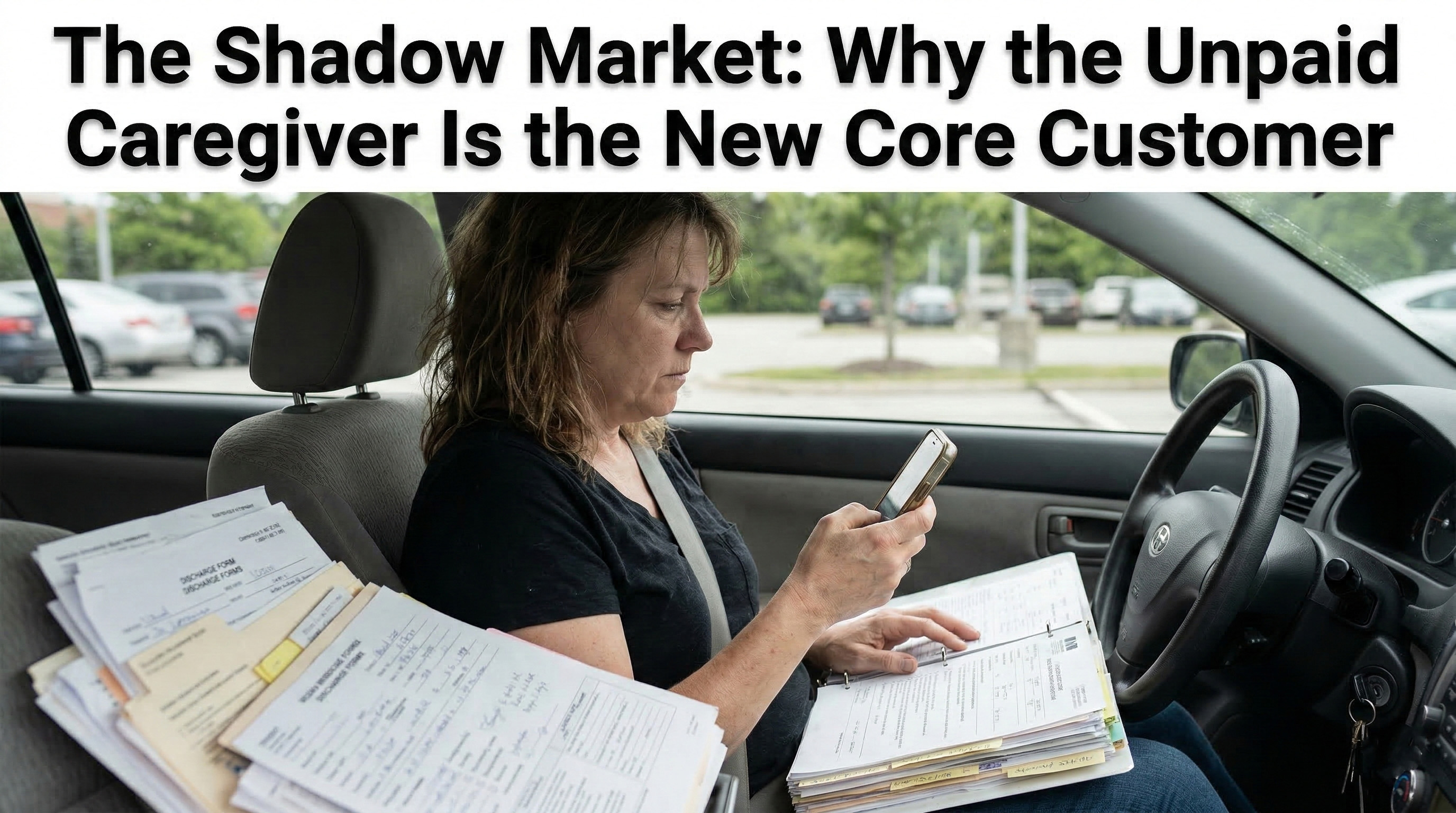
Consider what a long-distance daughter managing her father’s care actually does in a normal week. She calls an insurer about a denied claim. She tries to decode discharge instructions. She texts a sibling who does not answer. She compares home care agencies. She reschedules a specialist appointment. She double-checks whether the transportation service is confirmed. She tries to remember whether the new medication replaced the old one or was added to it. She takes time off work because the aide did not show up, again, and no one else can step in.
This is not a monitoring problem. It is an operations problem.
The first wave of caregiving technology was built around visibility: detect the fall, track the movement, record the sleep, flag the anomaly, send the alert. The older adult was framed as the monitored subject, and the caregiver was framed as the receiver of alarms. But surveillance is not the same thing as coordination. In many cases, it simply digitized anxiety. The older adult felt managed. The caregiver felt more responsible, not less, because every notification reinforced the same truth: the system still depended on her to interpret, decide, call, fix, and absorb.
What caregivers need is not more pings. They need infrastructure. They need a shared operational layer where family members, aides, care managers, agencies, and clinicians can coordinate around the same reality without routing everything through one exhausted person’s memory.
Why Consumer-Only Care Tech Hits a Wall
Even thoughtful family caregiving apps tend to reach the same boundary: they stop at the edge of the family.
A daughter can maintain a medication list with her brother. She can create reminders. She can upload documents. But the minute care extends into the formal system—home health, transportation, agency staffing, discharge planning, geriatric care management, primary care follow-up—the architecture fractures. Families operate in one silo. Professional providers operate in another. Information travels between them through calls, voicemails, forwarded PDFs, handwritten notes, and one overburdened person acting as a human API.
That is the structural gap.
The companies most likely to matter in the next phase of aging infrastructure will not be the ones that merely add another device to the home. They will be the ones that treat caregiving as a multi-stakeholder workflow problem. They will build systems that connect informal caregivers to the professional care environment already surrounding the older adult. Not as an afterthought. Not as a “family portal.” As core product architecture.
That is where a B2B2C model becomes more than a go-to-market choice. It becomes a product truth. When the family is connected into the same operating layer as agencies, care coordinators, and providers, adoption no longer depends on one household forcing a standalone app into an already chaotic life. Professionals use the platform because it reduces friction in communication and coordination. Families use it because it finally gives them access to the ecosystem they have been manually bridging for years.
In other words, the product stops behaving like a gadget and starts behaving like infrastructure.
A Necessary Limit: What Technology Cannot Solve
There is an important line that serious companies should not blur.
Caregiving strain is not only logistical. It is psychological, financial, and physiological. The Family Caregiver Alliance notes that family caregivers commonly experience higher levels of stress, anxiety, depression, and other negative mental health effects. CDC reporting has likewise found that frequent mental distress and diagnosed depression are more prevalent among caregivers than among noncaregivers. Broader medical literature continues to link sustained caregiving burden with significant physical and emotional strain.
A coordination platform can reduce administrative chaos. It can lower communication friction. It can make care plans more visible, responsibilities clearer, and handoffs less fragile. But it is not a therapist, not respite care, not a wage replacement system, and not a cure for grief. Good technology can remove operational burden. It cannot erase the human cost of loving someone through decline.
That distinction matters, because credibility in this market depends on restraint as much as ambition.
Build for the Person Holding the System Together
The future of aging well will not be decided only by better sensors, cleaner dashboards, or more elegant wearables. It will be decided by whether the industry finally builds for the person currently holding the whole arrangement together by force of attention.
She is in the hospital parking lot answering a work email with one thumb and a pharmacy message with the other. She is the one translating between the family, the provider, the aide, the insurer, and the calendar. She is the one who knows which detail matters, which phone call cannot be missed, and which crisis is still survivable if she gets to it in time.
She is not a secondary user. She is not merely a concerned daughter, a distribution channel, or an upsell opportunity at Thanksgiving. She is the operational backbone of an underbuilt care system and, increasingly, its economic decision-maker.
Any AgeTech roadmap that begins with the assumption that the older adult alone is the customer will keep producing the same result: useful features, decent intentions, and products that end up in drawers because they solved the wrong problem for the wrong person.
It is time to build for the caregiver.
Not around her.
For her.