The WhatsApp Illusion
The public image of family caregiving is sentimental and incomplete. It shows a daughter sitting beside her mother at the kitchen table, a son driving his father to a medical appointment, a grandchild helping with groceries. Those moments are real, but they are not the full job. The actual work of keeping an older adult safely at home looks less like a series of gestures and more like the daily management of a decentralized care network. It is not simply an act of love. It is a continuous operational effort with medical, logistical, and financial consequences.
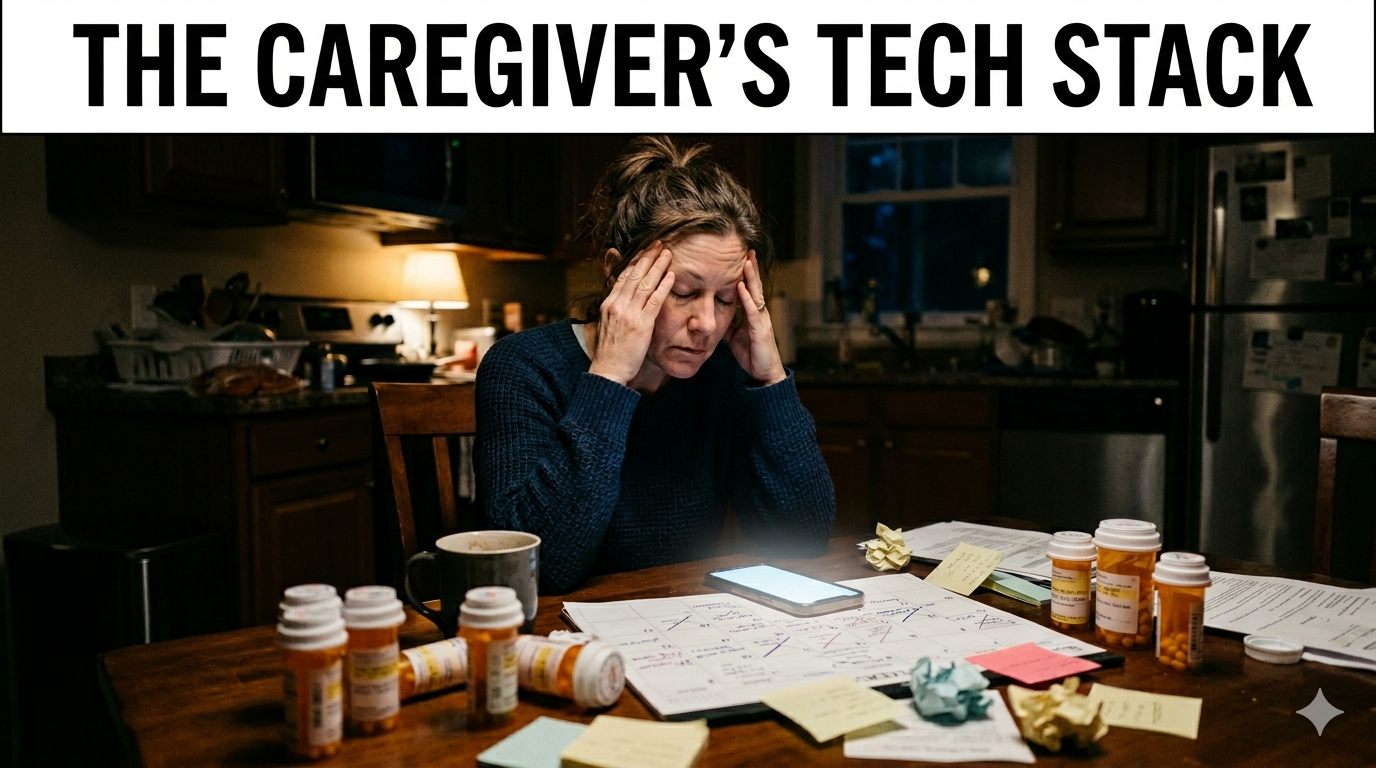
Most families do not recognize this at first. They believe they are stepping into a supportive role. Then the responsibilities begin to multiply. One person is handling refill dates for medications. Another is coordinating transportation to specialists. A neighbor is checking in after lunch. A home aide is observing subtle changes in appetite or mobility. A sibling living in another city wants updates, but only sees fragments. Soon, the family is relying on a loose collection of tools that were never built for clinical coordination: a group chat where a critical medication update disappears between photos of grandchildren, a whiteboard in the kitchen that no one remembers to revise, a spreadsheet that feels promising for one week and is abandoned by the second. The result is a dangerous illusion of communication without true operational control.
This is the WhatsApp illusion of modern caregiving. The family feels connected because messages are moving, but information is not being governed. Tasks are discussed, but ownership is unclear. Changes are noticed, but not documented in a durable way. Everyone assumes someone else saw the update, remembered the instruction, or completed the errand. In reality, the household is functioning like a small unlicensed facility, but without the systems that facilities depend on to remain safe.
The Supply Chain of Care
Aging in place is often described as a medical issue, or as a moral commitment to keep a loved one at home. Both descriptions are correct, but neither is sufficient. Aging in place is also a supply chain problem. It involves procurement, scheduling, inventory control, information transfer, contingency planning, and risk management. Once that framing is made explicit, many of the failures families experience become easier to understand.
If a pharmacy refill is missed before a holiday weekend, that is not just an unfortunate oversight. It is a supply chain failure. If the morning aide notices dizziness, but the evening daughter never receives that information and administers medication without context, that is not simply a communication problem. It is an information silo. If a walker is moved from one room to another, a loose rug remains in the hallway, and no one documents the increased instability after a recent illness, the issue is not bad luck. It is a breakdown in hazard monitoring and risk mitigation.
Businesses do not attempt to manage this level of complexity through memory and goodwill alone. They use structured systems because structured systems reduce failure. A company would never run inventory, staffing, incident reporting, and time-sensitive vendor coordination through scattered text messages and a kitchen whiteboard. Yet this is precisely how families are expected to manage an older adult's medications, meals, appointments, mobility needs, home safety issues, and emergency response plans.
That expectation is not only unrealistic. It is ethically unstable.
The AgeTech Blindspot
One of the clearest blindspots in the current AgeTech market is the belief that the primary problem of aging at home can be solved with more devices for the older adult. The market offers sensors, wearables, voice assistants, reminder tablets, monitoring cameras, and fall detection tools. Some of these products are useful. Many can provide genuine value. But the industry has over-invested in hardware alerts while under-investing in operational infrastructure.
A sensor can tell a family that something has gone wrong. It cannot tell them who is responsible for responding, whether the medication supply is already running low, whether the last three missed meals were documented, whether the home aide communicated a concern, or whether the next appointment requires fasting, transportation, and updated paperwork. Alerts are not systems. Notifications are not coordination. Devices can generate data, but they do not resolve the daily friction that exhausts caregivers and creates preventable risk.
This is the central market failure. We have treated the older adult as the end user of care technology, while ignoring the fact that the family is often the true operator of the care environment. The real unmet need is not another isolated gadget. It is a shared operational layer for the people trying to keep the entire home-based care system functioning.
The Caregiver's ERP
What families need is the equivalent of an enterprise resource planning system for care. Not a corporate interface, and not a cold administrative dashboard detached from human reality, but a centralized structure where the right information is visible to the right people at the right time. Schedules should not live in one place, medication notes in another, grocery needs in a text thread, and mobility concerns in someone's memory. Inventory, tasks, appointments, observations, and responsibilities need to exist inside a common operational environment.
When this infrastructure exists, the burden on the primary caregiver changes significantly. Cognitive load is no longer concentrated in one exhausted person who acts as scheduler, historian, dispatcher, and safety monitor. Instead, responsibility becomes distributed, visible, and verifiable. The daughter does not have to remember every refill date because the system tracks it. The son does not need to wonder whether physical therapy was completed because it is documented. The aide does not have to rely on a verbal handoff because updates are entered into a shared record. The family stops improvising and starts coordinating.
The Logistics of Love
This is not a matter of convenience. It is a matter of clinical reliability. Many caregiver crises begin as small operational failures that compound quietly over time. A missed note leads to a missed refill. A missed refill leads to symptom escalation. Symptom escalation leads to an urgent visit, a hospitalization, or a preventable decline that the family experiences as sudden, even though the underlying breakdown was gradual and logistical. Burnout follows the same pattern. It rarely arrives because the caregiver lacks commitment. It arrives because the caregiver is forced to run a complex, high-stakes system without the basic tools required to do so safely.
The future of aging safely at home will not be secured by love alone, and it will not be secured by hardware alone. It will depend on whether we finally accept what families have already learned through exhaustion: caregiving is organizational work. It is distributed, time-sensitive, risk-exposed, and operationally dense. Families have been forced to become care organizations without any of the infrastructure that real organizations require.
Caregiver burnout is rarely a failure of devotion. More often, it is the predictable outcome of operational overload inside a system built on fragmented memory. If society wants older adults to remain at home safely, then society must stop romanticizing family caregiving as informal help and start treating it as the complex care logistics function it has become. Only then can aging in place move from aspiration to reliable reality.