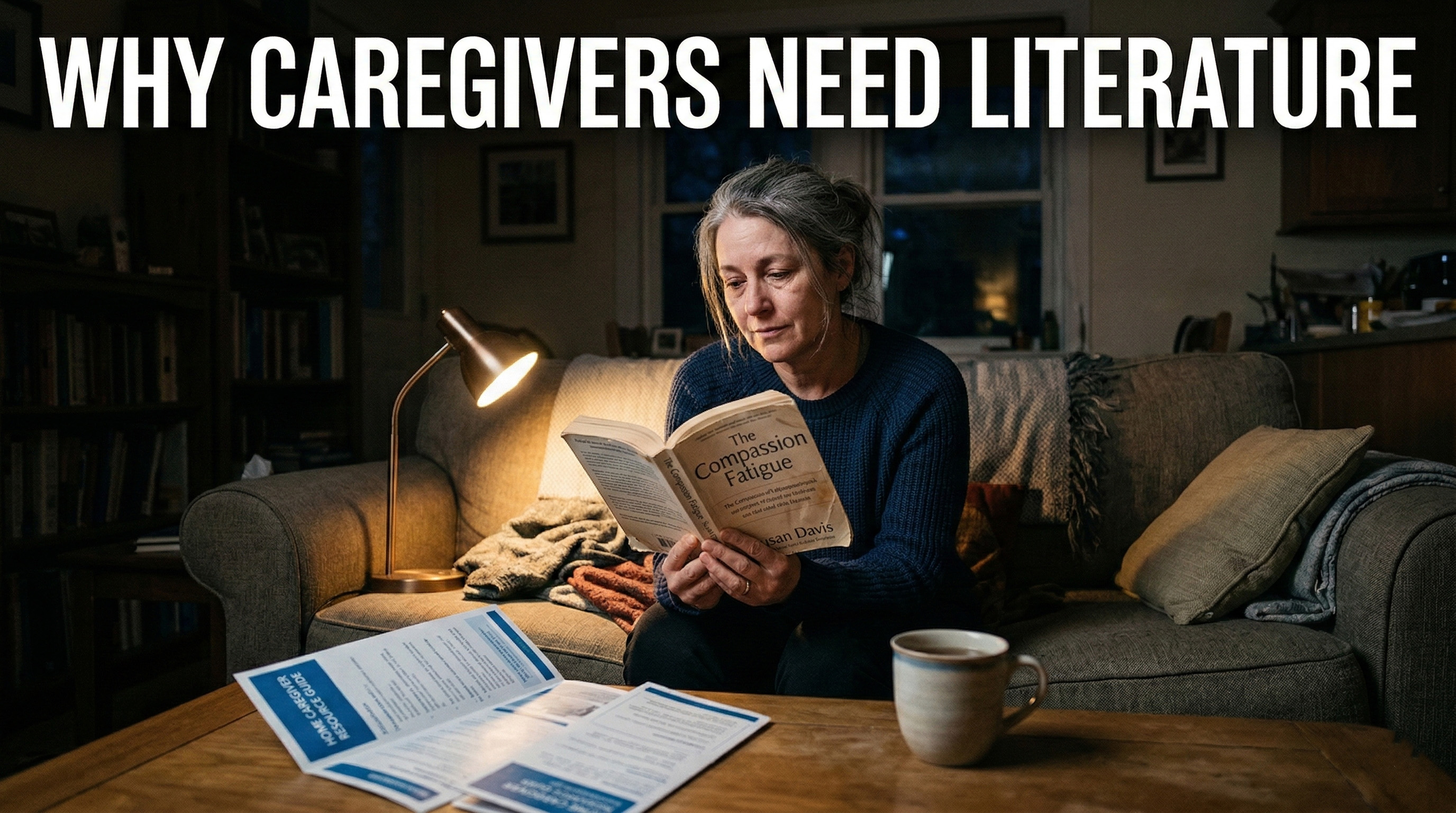
The fluorescent lights in the neurologist's waiting room don't flicker—they hum. It's a low, institutional drone that becomes the soundtrack to one of the most disorienting afternoons of your life. Your mother has just been evaluated. The doctor was kind, efficient, thorough. And now a medical assistant is handing you a tri-fold pamphlet printed on card stock. "Managing the Middle Stages of Dementia." It has bullet points. It has clip art of a smiling older woman holding a pill organizer. It has a QR code linking to a hospital website you may never visit.
You fold it into your coat pocket next to your car keys and your mother's hand, and you walk into the parking lot carrying the full weight of a future that no pamphlet was designed to hold.
The Structural Limits of the Medical System
Let me be clear about something: that pamphlet matters. Fall-prevention checklists save hips. Medication-management guides prevent dangerous interactions. Clinical information materials, at their best, distill complex medical knowledge into actionable steps for overwhelmed families, and dismissing them would be irresponsible. Many health systems go further—deploying social workers, care navigators, and support groups that try to address the human dimensions of illness alongside the clinical ones.
But there is a structural limitation baked into even the best clinical information, and it has nothing to do with the quality of the pamphlet or the compassion of the doctor who provided it. Healthcare systems are architecturally organized around safety, symptom management, and functional outcomes. They are designed to answer questions like: How do we prevent falls? How do we manage agitation? When should we adjust the dosage? These are urgent, necessary questions. They are also radically incomplete—because they address the patient's condition without fully holding the caregiver's experience.
The Unspoken Toll: Anticipatory Grief and Ambiguous Loss
And the caregiver's experience is not one thing. It is several distinct burdens layered on top of each other, often simultaneously, often in silence.
There is logistical strain—the grinding operational work of coordinating appointments, managing medications, negotiating with insurance, and communicating across a family that may not agree on anything. There is the phenomenon clinicians call caregiver burden: the cumulative physical, financial, and emotional toll of sustained caregiving that research has consistently linked to increased rates of cardiovascular disease, immune suppression, and mortality. There is the particular disorientation of role reversal—of becoming the decision-maker, the protector, the parent of your own parent, a shift that restructures identity in ways that few people are prepared for.
And then there is something quieter, harder to name, and almost entirely absent from clinical handouts: anticipatory grief.
Anticipatory grief is not depression, though it can coexist with it. It is not burnout, though burnout can deepen it. It is the mourning that begins before death—the slow, accumulating awareness that someone you love is diminishing, that the person sitting across from you at dinner is becoming someone you don't fully recognize, and that every small loss (a word she can no longer find, a memory he no longer holds) is a small funeral you attend alone. The concept traces back to psychiatrist Erich Lindemann's foundational 1944 work on grief, and it has been further refined by decades of thanatological research. Yet it remains one of the most under-discussed emotional realities in family caregiving.
Closely related is what psychologist Pauline Boss has termed ambiguous loss—a loss that remains unclear, unresolved, without the finality that allows conventional mourning to proceed. When a parent with dementia is physically present but psychologically receding, the family exists in a sustained state of ambiguity: you cannot fully grieve because the person is still alive, but you cannot fully relate to them because the person you knew is increasingly absent. This is not a problem that grab bars solve.
Literature as Psychological Infrastructure
So what does help?
Not exclusively therapy—though therapy is essential for many caregivers, and I will return to that point. And not exclusively community, though community matters enormously. What I want to argue is that one undervalued form of support is something deceptively simple: literature.
Not literature as escapism. Not literature as a luxury for people with leisure. Literature as witness—as the act of one human being setting down, in honest and careful language, an experience that another human being has been enduring in isolation.
When Atul Gawande published Being Mortal in 2014, he gave ordinary families a language for questions the clinical system was not structured to ask: What does it mean to live well when the body is failing? Who decides what a good day looks like? What do we owe the people we love when medicine has reached its limits? The book did not offer protocols. It offered something harder to prescribe and more durable—a narrative framework for sitting with uncertainty.
Roz Chast's graphic memoir Can't We Talk About Something More Pleasant? performed a different kind of work. With dark humor and an almost ruthless emotional honesty, Chast documented the exhaustion, absurdity, tenderness, and resentment involved in managing her elderly parents' decline. For many caregivers, it was the first time someone had said aloud the things they had been thinking in private: that love and frustration are not opposites, that caring for a parent is simultaneously an act of devotion and a slow experience of personal erasure.
Nancy Mace and Peter Rabins's The 36-Hour Day—long considered the essential reference for dementia caregivers—earns its title from a truth that no clinical system has adequately answered: the days are not long enough for what is being asked of you.
These books do not cure anything. They do not replace therapy, medication, or competent clinical care. But they do something that pamphlets, however well-designed, cannot: they tell the caregiver, This experience has a shape. Other people have lived inside it. You are not failing—you are carrying something that is genuinely, structurally, impossibly hard.
For a caregiver trapped in months of silent emotional overload, a single honest paragraph can break the isolation more effectively than a dozen informational handouts. This is not sentimentality. It is a recognition that human beings process suffering through narrative, and that caregiving—particularly the long, ambiguous, anticipatory grieving kind—generates a form of suffering that desperately needs narration.
The Practical Knot: Finding the Margin to Read
But here is the practical knot: the caregivers who most need this kind of reflective space are often the ones least able to access it. Not because they lack interest, but because the operational demands of caregiving consume every available margin. Evenings disappear into pharmacy calls, insurance disputes, aide rescheduling, and family group chats that have become their own exhausting second job. The logistical chaos of caregiving doesn't just steal time. It fragments attention so thoroughly that sustained reflection—reading, thinking, feeling—becomes nearly impossible.
This is the specific, limited problem that a platform like Agefully is built to reduce. Not the grief. Not the ambiguous loss. Not the anticipatory mourning or the role reversal or the depression that may require professional clinical intervention. Those belong to therapists, to communities, to the caregiver's own slow inner work. What Agefully addresses is the operational friction—the coordination of schedules, professionals, and family communication that currently scatters across text threads, sticky notes, and sheer willpower. Reducing that friction does not heal anyone. But it can restore a margin. It can return an hour. And sometimes an hour is enough to sit down, open a book, and feel, for the first time in months, that someone understands.
A clear and necessary note: Neither literature nor logistical coordination is a substitute for clinical care. Caregiver burnout, chronic anxiety, and depression are serious conditions that require the attention of licensed therapists and medical professionals. If you are experiencing persistent emotional distress, please seek qualified professional support. What books and better logistical tools can do is create conditions in which other forms of healing become more accessible—they clear ground, but they are not treatment.
Room to Breathe
Caregiving is one of the oldest human acts. Long before clinical systems existed, families sat with their aging and their dying, and they made sense of it the way human beings have always made sense of what is hardest—through story, through shared witness, through the imperfect consolation of knowing that someone else walked this road and found words for what they saw.
The pamphlet has its place. It speaks to the body's mechanics, and it should. But the caregiver is not a mechanic. The caregiver is a person standing in a parking lot, holding a mother's hand, carrying a grief that has no name yet, and needing—more than instructions—language, recognition, and room to breathe.