Introduction
In aging policy, community is almost always placed on the wrong side of the hierarchy. It appears under headings such as “activities,” “social life,” and “well-being” — never under those dealing with health, prevention, or care pathways. The vocabulary surrounding it confirms this relegation: conviviality, social connection, collective activities. In other words, community is treated as something added once fundamental needs have already been met — care, safety, functional support.
This hierarchy is intellectually fragile and politically costly. It rests on a conception of health reduced to the biomedical sphere, while ignoring a substantial body of evidence. Since the foundational work of Berkman and Syme (1979) on mortality and social networks in the Alameda County cohort, and later the meta-analyses by Holt-Lunstad and colleagues (2010, 2015), the evidence has converged: social integration is not a trivial correlate of health. It is an independent predictor of morbidity and mortality, including after adjustment for conventional clinical variables.
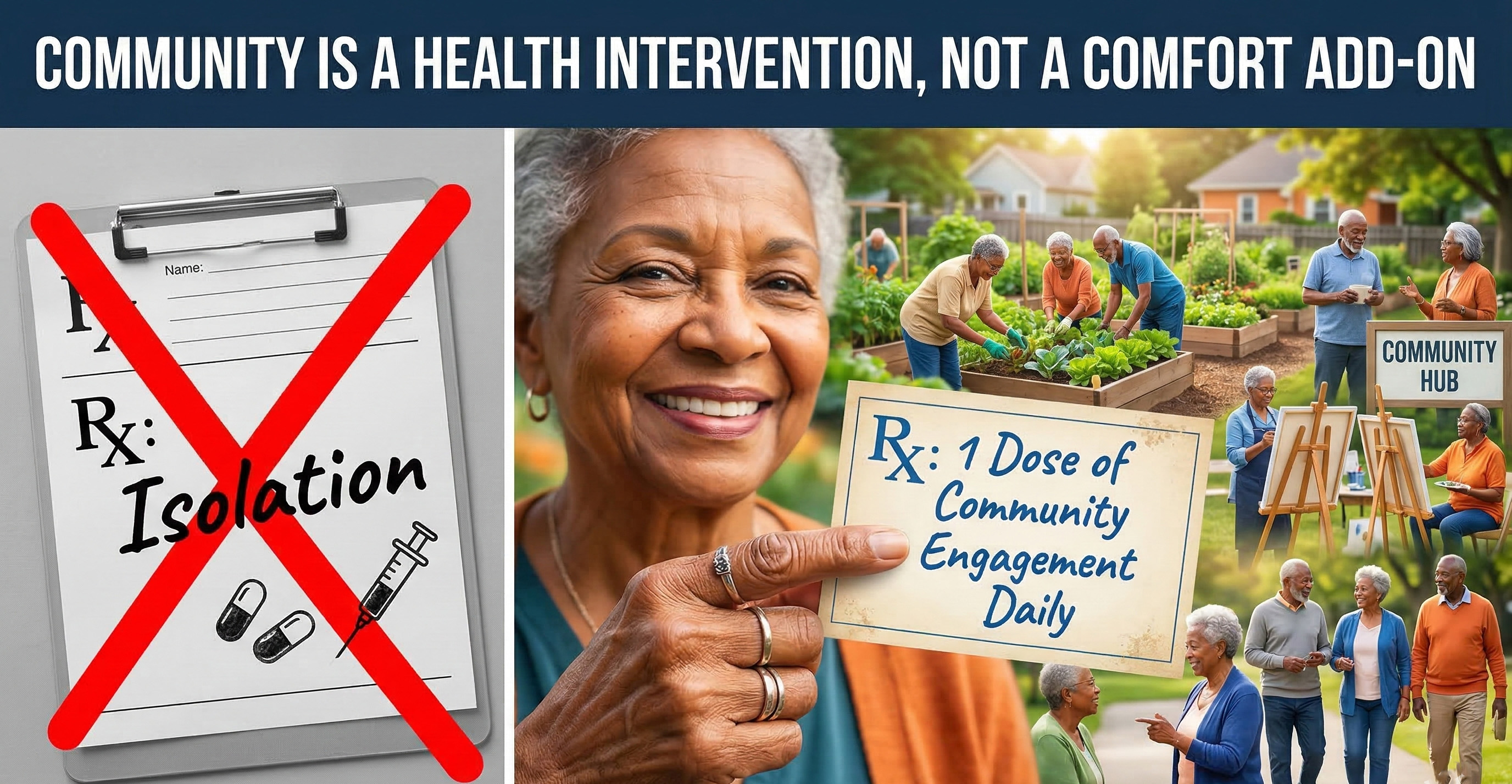
This article defends a simple but demanding thesis: community participation, embeddedness in reciprocal social networks, and access to a local social infrastructure do not belong to the realm of comfort. They are determinants of health. And that distinction carries concrete implications — budgetary, organizational, and professional — for the way our societies organize aging.
Health Extends Beyond Clinical Care
Western health systems remain organized around a biomedical core: diagnosis, pharmacological treatment, chronic disease management, hospital intervention. What falls under the social sphere is treated as a complement, financed at the margins, and delegated to other institutions. This separation is not merely budgetary; it is cognitive. Health professionals are trained to identify pathologies, not relational deprivation.
Yet the work of Marmot (2005) and the WHO Commission on Social Determinants of Health (2008) established that the conditions in which people live, work, and age explain a substantial share of health inequalities across groups. For older adults, this reality takes a specific form: much of what determines the quality of aging trajectories — maintenance of autonomy, psychological stability, the capacity to cope with loss — does not belong to curative medicine. It belongs to the concrete organization of daily life and to the social environment in which that life unfolds.
The point is not to oppose the medical and the social. It is to recognize that the range of interventions that genuinely affect the health of older adults extends far beyond what the health care system can deliver in a fifteen-minute consultation.
What “Community” Means in This Article
The term is too often used as though it were self-evident. It needs to be unpacked. Four dimensions are analytically distinct.
The territorial dimension: the neighborhood, the local surroundings, spaces accessible on foot — shops, benches, markets, everyday places of passage. This dimension depends directly on urban planning and transportation.
The relational dimension: the network of regular interactions — neighbors, friends, association members, familiar figures. What matters is not the number of contacts, but their stability, reciprocity, and perceived quality.
The identity dimension: occupying a recognized place, being expected somewhere, mattering to others in an identifiable role — volunteer, trusted neighbor, active group member.
The infrastructural dimension: the material supports that make community life possible — community centers, libraries, associations, shared gardens, adapted transportation systems.
When this article refers to community as a health intervention, it means the articulated whole formed by these four dimensions. Not a warm abstraction. A concrete set of conditions that makes insertion into ordinary social life possible.
Mechanisms: How Community Acts on Health
Psychological Regulation and Protection Against Depression
The association between social isolation and depression in older adults is one of the most consistently replicated findings in gerontology. Cacioppo and colleagues (2006, 2010) showed that perceived loneliness — distinct from objective isolation — is associated with greater activation of the hypothalamic-pituitary-adrenal axis, elevated cortisol, and increased inflammatory markers. Community operates here through two pathways. First, it offers a framework for emotional regulation: the ability to verbalize, to put difficulties into perspective, to feel understood. Second, it provides ongoing social validation — being greeted, expected, noticed — which helps contain the sense of erasure produced by the cumulative losses of aging.
These are not vague effects. They are documented processes, with identifiable biological correlates.
Cognitive Stimulation
Regular social interaction recruits attention, working memory, language, mental flexibility, and the interpretation of other people’s intentions. A sustained conversation, the coordination of a group activity, or the negotiation of disagreement all involve executive operations that isolation does not mobilize.
Data from the Rush Memory and Aging Project (James et al., 2011) show that the most socially active individuals display a significantly lower rate of cognitive decline over twelve years of follow-up. Similar findings emerge from SHARE studies in Europe. Caution is necessary: selection bias is never fully eliminated, and the most socially engaged individuals are often also those with better baseline health. Yet the consistency of the association, its persistence after adjustment for education level and comorbidities, and its coherence with known neuropsychological mechanisms justify taking it seriously as a lever for prevention.
Behavioral Structuring and Functional Maintenance
Community also affects health through a more prosaic but equally important channel: it organizes everyday life. A weekly appointment, a group activity, or a neighborhood routine imposes rhythm. These commitments require older adults to go out, get ready, keep time, and expose themselves to walking and movement. With advancing age, it is not only disease that threatens autonomy; it is the gradual disorganization of ordinary behaviors. When no social obligation structures the day, the risk of sedentary living, temporal drift, and withdrawal into the home increases.
This function of external regulation cannot be replaced by prescription. The health care system can treat the consequences of inactivity; it cannot generate reasons to leave the house.
Moreover, the movements, gestures, and modest but repeated physical efforts implied by community life contribute to maintaining functional capacity — what Katz (1983), and later the frailty literature (Fried et al., 2001), identify as the foundation of everyday autonomy. Here, community acts less through a targeted intervention than through continuous exposure to ordinary physical demands.
Role Maintenance and Identity Continuity
Haslam, Jetten, and colleagues (2009, 2018) have shown, through the social identity approach to health (the “social cure”), that the number of groups with which a person identifies significantly predicts well-being, resilience in the face of transitions, and recovery after a health event. What protects is not passive proximity to others, but active identification with meaningful forms of belonging.
In later life, this dimension becomes critical. Retirement, widowhood, and the decline of everyday demands strip away roles that once structured identity. Community offers replacement positions — volunteer, transmitter of experience, active member, trusted neighbor — that help preserve a sense of usefulness and continuity. This is not a matter of “subjective well-being” in any weak sense. It is a condition for the ability to project oneself forward, to act, and to retain some grip on one’s own existence.
What Makes Aging Specifically Vulnerable to the Absence of Community
All of the mechanisms described above operate at every age. But aging concentrates factors that amplify their significance and make their absence more costly.
First, alternative sources of social structure diminish. Work disappears. Children move away. Friends die. Networks contract through attrition, often without replacement. For many, the local community becomes the last accessible space of regular interaction.
Second, barriers to access increase. Mobility declines. Driving is given up. Public transportation is inadequate or nonexistent in rural areas. Fatigue, pain, and fear of falling restrict movement. Isolation is therefore not always a choice; it is often the product of a failing physical and institutional environment.
Finally, the health consequences of isolation are more severe in older adults. Holt-Lunstad et al.’s meta-analysis (2015), covering 3.4 million participants, shows that social isolation, loneliness, and living alone increase mortality risk by 26 to 32 percent. This effect is comparable to moderate smoking and greater than obesity. In a population already made vulnerable by comorbidities and reduced physiological reserves, the absence of community is not a discomfort. It is a risk factor.
From Activities to Prevention: A Necessary Shift in Category
As long as community activities are classified under “leisure” or “sociocultural programming” budgets, they will remain the first to be sacrificed when budgets tighten. Reclassifying them as prevention is not a rhetorical maneuver. It has concrete consequences for funding, professional training, and the architecture of care pathways.
The British model of social prescribing illustrates this shift. Since the mid-2010s, the NHS has allowed general practitioners to refer patients to community-based activities — walking groups, arts workshops, shared gardens — through link workers. Evaluations remain preliminary, and effects are modest and context-dependent, but the principle is structurally important: it officially recognizes that referral to a social resource can constitute an act of care.
In France, the Conférences des financeurs de la prévention de la perte d’autonomie, created by the 2015 Aging and Society Adaptation law, opened a space for financing preventive actions that include a social dimension. But the logic remains largely top-down, fragmented, and insufficiently grounded in rigorous evaluation of outcomes.
Implications for Policy and Practice
If community is a determinant of health, then its absence must be treated as a modifiable health deficit. Several consequences follow.
Spatial planning becomes a public health issue. The closure of local shops, the elimination of rural transport routes, and the privatization of public spaces reduce community infrastructure. These decisions, generally made on profitability grounds, have health effects that remain uncounted.
Care pathways must include explicit social assessment. Community isolation should be identified in the same way as a clinical risk factor — not as vague “context” noted in the margins of a file, but as information relevant to care decisions and referral.
Professional training must evolve. Physicians, nurses, and social workers need tools to identify social isolation, treat it as a modifiable risk, and direct older adults toward local resources. That requires breaking with the still-dominant idea that loneliness is a private matter beyond the reach of professional action.
Limits and Precautions
Rigor requires that the scope of the argument not be overstated.
Not all forms of social participation are protective. Conflictual, intrusive, humiliating, or asymmetrical relationships can damage mental health. Rook (1984, 2015) has long documented the negative effects of poor-quality social interactions among older adults. The quantity of contact says little without quality. Reciprocity, the voluntary character of engagement, and respect for autonomy matter at least as much.
Access to community is profoundly unequal. Those who would benefit the most — geographically isolated older adults, low-income individuals, people with disabilities, members of stigmatized minorities — are also those who face the greatest barriers. A community-based policy that ignores these inequalities risks benefiting primarily those who are already best resourced.
Finally, community does not substitute for medical care. It does not compensate for untreated disease, severe material deprivation, or serious psychiatric disorder. The issue is not to replace the medical with the social, but to correct a conception of health that systematically underestimates what the relational environment does to aging trajectories.
Conclusion
Community is not a pleasant add-on to be distributed after care has been provided. It regulates affect, stimulates cognition, structures behavior, sustains functional capacity, and supports identity continuity. These effects are documented, their mechanisms are identifiable, and their magnitude is comparable to that of many recognized medical interventions.
As long as public policy continues to classify community participation under secondary headings, it will continue to produce a widening gap between what research knows and what institutions do. In societies where the older population is growing, health systems are saturating, and social isolation is reaching epidemic proportions, that gap is no longer merely a conceptual defect. It is a measurable human and budgetary cost.
The question is no longer whether community influences the health of older adults. The evidence is available. The question is whether decision-makers, funders, and professionals are prepared to draw operational consequences from it.